Lightning Link is played on venue machines in Australia; online pages using its name do not make it an authorised real-money option.
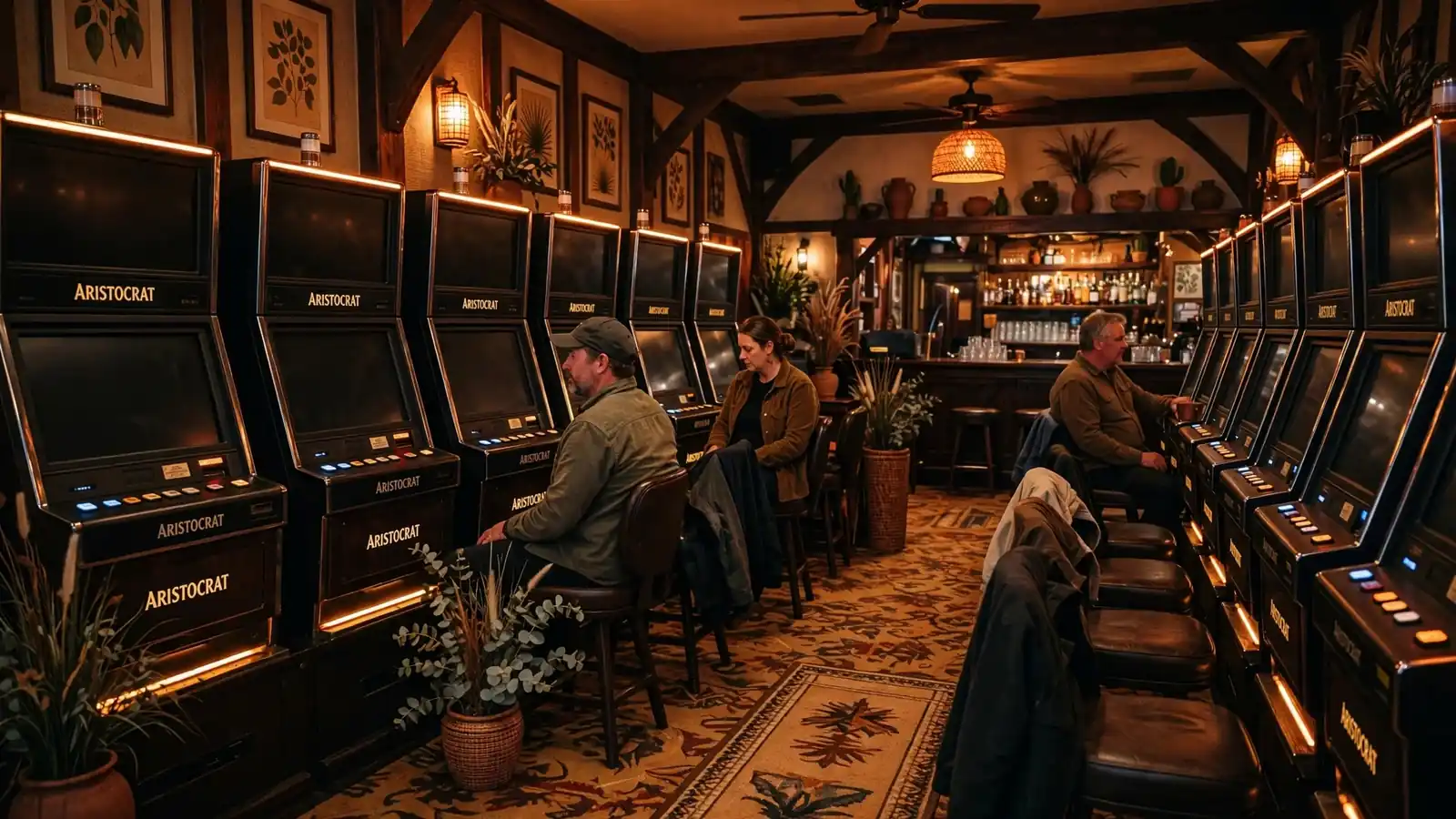
Lightning Link is a game series developed by Australian company Aristocrat. In Australia, it is played on machines in venues; it is not offered as a real-money online game to players in the country. That distinction matters because an online page using the game’s name does not change where the game is available or the legal status of the service behind it.
The words “Lightning Link casino” can suggest a conventional online casino product, but that is not the Australian arrangement. Lightning Link is a venue-based game, not an online casino game that Australian residents can access for money. References to Lightning Link online or to an online casino with Lightning Link may describe a search result or an offshore site’s presentation, rather than an authorised Australian online offering.
The legal framework is federal. Under the Interactive Gambling Act 2001, it is illegal for operators to provide real-money online casino games, including pokies, to people physically located in Australia. The law covers the provision of prohibited interactive gambling services; it does not turn venue machines into online products simply because the same title appears on a website. For Lightning Link, the practical distinction remains direct: venue machine play is available in Australia, while real-money online play is not.
Choosing a Lightning Link online pokies site involves checking the operator details that matter to you, including licensing and any stated payment information. Use these notes as a concise reference when considering your options in Australia for 2026.
7Bit Casino
7Bit Casino is operated by Dama N.V. and holds a Curacao license.
Wild Tokyo
Wild Tokyo is Curacao-licensed and lists a minimum deposit of A$10. Its stated payout times are 30–60 minutes for crypto and 1–5 days for fiat.
SkyCrown
SkyCrown is licensed by the Tobique Gaming Commission. It lists crypto payouts at around 10–15 minutes, fiat payouts at 1–5 days, and a minimum deposit of A$30.
Neospin
Neospin holds Curacao Gaming Control Board license OGL/2023/176/0095, issued to Hollycorn N.V.
Uptown Pokies
Uptown Pokies has operated since 2017 and is licensed in Curacao. Its listed minimum deposit is A$20.
WinSpirit Casino
WinSpirit Casino holds Curacao eGaming license OGL/2024/923/0383, issued to Antillephone N.V. It lists a minimum deposit of A$30.
DragonSlots Casino
DragonSlots Casino is licensed by the Curacao Gaming Authority, with Jumpman Gaming Ltd identified as the operator.
Thor Casino
Thor Casino is licensed in Curacao through Antillephone N.V., with Versus Odds B.V. identified in the license details. Its listed minimum deposit is EUR 20.
Vegaz Casino
Vegaz Casino holds Curacao license OGL/2024/1335/0780 and lists a minimum deposit of EUR 20.
LuckyVibe
LuckyVibe holds Curacao Gaming Control Board license OGL/2023/176/0095, issued to Hollycorn N.V.
Enforcement sits with the Australian Communications and Media Authority (ACMA), the federal agency responsible for applying the Act and monitoring compliance with interactive gambling rules. Its role includes action against services that provide prohibited gambling or promote access to it. ACMA may ask Australian internet service providers to block websites associated with prohibited interactive gambling services or their advertising. A site loading at a particular moment is therefore not evidence that its service is lawful or that it is an official online version of Lightning Link.
ACMA’s enforcement record gives that distinction practical weight. Following enforcement actions, it has blocked more than 1,455 illegal gambling and affiliate websites since November 2019. The reported count of services that have left the Australian market since enforcement began in 2017 is not consistent across accounts: one figure is more than 210, while another is over 190.
The Interactive Gambling Act is directed at operators providing prohibited services, rather than at individual players. There are no known cases of Australian players being prosecuted for gambling on offshore sites. That does not make an offshore Lightning Link offer legal, officially supported or equivalent to playing the machine in an Australian venue. Operator conduct and player exposure are separate questions; a lack of known prosecutions does not convert a prohibited online service into a permitted one.
 Live Baccarat Online in Australia: Access and RulesExplore international access, table formats, rules and AUD balances, while noting that Australian-licensed operators cannot offer online casino games.
 Trusted Online Casinos in Australia: What the Law SaysLearn how Australian law treats offshore casino sites, why ACMA blocks illegal services, and why payment methods or badges do not establish…
This is why “Lightning Link online casino” is not an accurate description of availability in Australia. A website may use the title in its text, display related imagery or refer to a casino-style game, but those details do not establish that Aristocrat supplies the real-money online product to Australians. The relevant fact is the mode of play: Lightning Link is played on venue machines here, not through a real-money online casino.
Affiliate-linked content may contain sponsored recommendations. That disclosure concerns how a page may be funded; it does not alter the legal position of online casino services or make an unavailable game available online. An affiliate reference is not an endorsement by ACMA, Aristocrat or a venue operator.
Real-money gambling content is restricted to adults aged 18 and over. That age threshold does not create an online entitlement: even for adults, the law prohibits operators from supplying real-money online casino games to people in Australia. The distinction between venue access and online provision remains the central point when assessing any claim that Lightning Link is available as an Australian online casino game.
“Free play” describes a different kind of balance from money held in a gambling account. In a social casino-style game, play is conducted with virtual credits. Those credits represent access to the game, not a cash balance, and the distinction matters more than the word “free” in the title.
In a social casino-style game, play is conducted with virtual credits that represent access to the game rather than a cash balance.
For Lightning Link, a free-play version should be understood as entertainment using virtual currency, not as a way to play for a cash return. The Interactive Gambling Act treats social casino platforms differently from gambling services where players can win real money. The reason is the outcome: virtual-credit play does not provide a real-money win.
That boundary is straightforward, though promotional language can make it sound less so. A displayed balance may rise or fall during play, but a larger virtual balance is not a larger financial asset. It should not be counted as income, a withdrawal amount or money owed to the player. A number on screen is not cash merely because it is presented in a familiar balance format.
The term can refer to the currency used for play rather than every condition attached to access. A social game may present a virtual balance, while its own access terms explain how that balance is used. The word “free” alone does not establish that a platform has no paid features, nor does it establish that virtual credits can be exchanged for anything of value. Those are separate questions, and the platform’s terms determine what applies to its own service.
The essential distinction is between a simulated game balance and money that can be won. Virtual credits used for a social version do not turn that version into real-money gambling. Equally, a game’s familiar appearance does not change the nature of its currency. If there is no real-money win, the displayed play remains on the virtual side of the boundary described by the IGA.
For the same reason, a social game should not be presented as a route to prizes or cash. A player can engage with a game using virtual credits without acquiring a claim to a monetary payout. Treating the credits as if they could later be cashed out would confuse the game’s scorekeeping with a financial balance.
A useful way to assess any free-play offer is to separate three things: the game itself, the currency used within it and the conditions under which that currency is available. A familiar game name identifies the content; it does not tell whether the balance is money. The currency’s stated use and the platform’s terms are what matter.
In a social casino setting, virtual credits are for play within that setting. They are not a substitute for a deposit, and a high balance does not imply that an equivalent amount can be withdrawn. Nor should a virtual-credit session be described as a way to test the value of a future cash wager. The balance and outcome belong to the social game, not to a real-money account.
This also limits what “winning” can reasonably mean in free play. A game may show a successful result or increase its virtual balance, but that is an in-game outcome. It does not establish that money has been won. The practical accounting treatment is zero cash value unless the platform clearly says otherwise—and a social game that relies on virtual currency is not a promise of cash or prizes.
The line is therefore not whether a screen resembles a venue machine or whether its play looks familiar. It is whether the player can win real money. Under the IGA, social casino platforms built around virtual currency fall outside the definition of gambling when real-money winnings are unavailable. That legal distinction does not make every product using the word “free” identical; it explains why virtual-credit play and real-money gambling are not interchangeable categories.
This page is affiliate-linked and may contain sponsored recommendations. That disclosure does not alter the distinction between virtual credits and cash, and it is not a recommendation to use a real-money gambling service.
A specialist game review describes Hold and Spin as a feature in which positions occupied by special symbols remain locked while the other positions spin independently. The distinction is between positions that are held in place and positions that continue to change. It is a change in how the playing area behaves, not simply a label for an ordinary spin.
The word “independently” matters. The positions that continue spinning are not described as moving together as one fixed block; each can change without requiring the others to show the same result. Meanwhile, a locked position keeps its special symbol in place during the feature. The board therefore combines held positions with separate moving positions.
That basic description is enough to explain why Hold and Spin feels different from a standard spin, without assuming additional rules. It does not establish what symbols trigger the feature, how many positions can lock, how long it continues, or what ends it. Those details should not be inferred from the feature’s name. A game description that uses “hold” and “spin” identifies the central contrast, but does not, by itself, specify every condition that governs a particular machine.
The feature can be understood as a state change in the game. Before it begins, the positions are part of the ordinary play sequence. During Hold and Spin, some positions are fixed and others remain active. This makes the changing positions easier to distinguish from the symbols already held in place. It also explains the feature’s name in plain terms: one part of the display is held; another part spins.
For anyone comparing descriptions of a Lightning Link pokie, this is the useful mechanical point to retain. Hold and Spin is not a promise that every position will move, nor does the description mean that a locked symbol changes on each subsequent spin. Its defining contrast is that the special-symbol positions stay put while the remaining positions spin separately. Any account that adds exact trigger conditions, a fixed sequence of attempts, or a guaranteed result is making a claim beyond that core description.
The same care applies to phrases such as “Lightning Link online pokies.” They do not alter what Hold and Spin means as a game feature. Nor does the existence of the feature establish a separate set of rules for every reference to a Lightning Link pokie. The mechanics can be explained without treating a phrase used to describe the game as evidence of additional functionality.
A game feature where special symbols remain locked in place while other positions spin independently.
This distinction is also useful when reading short descriptions that compress the feature into a few words. “Locked symbols” refers to positions that remain in place; “independent spins” refers to the positions that continue changing separately. Neither phrase should be stretched into claims about the probability of a particular outcome or the value of a result. The feature describes movement and position, not a financial outcome.
In practical terms, Hold and Spin is a visual and mechanical contrast between fixed special symbols and active positions. That is the verifiable core: some positions lock, and the others spin independently. More detailed rules depend on the specific game description, rather than on the feature name alone.
This page is affiliate-linked and may contain sponsored recommendations. That disclosure does not change the mechanics described here. Real-money gambling content is restricted to people aged 18 or older.
A Lightning Link machine is not a single fixed set of terms. The venue machine and its selected variant determine the stake options available on that unit, so the displayed settings matter more than a general description of the game. A figure reported for one installation should not be treated as a universal price of play.
A specialist review reports minimum bets ranging from $0.20 to $1.00 per spin, with the amount varying by venue and variant. That is a reported range, not a guaranteed schedule for every Australian machine. The minimum shown on a particular machine is the relevant figure; the maximum may also differ. Two machines carrying the same game name can therefore present different stake choices.
The distinction is financially direct. If the minimum stake is higher, each spin uses more funds, even though the title is familiar. If a player selects a higher stake, the amount committed per spin rises accordingly. Neither a larger stake nor a particular variant establishes that a return will follow. The sensible comparison is between the machine’s displayed options and the amount set aside for play, rather than between impressions of one version and another.
The jackpot label does not, by itself, explain who qualifies. A specialist review notes that eligibility may depend on wagering at the maximum bet. This is a condition to verify on the individual machine, not a rule that can safely be assumed to apply identically across all installations.
That condition changes the cost calculation. If eligibility is tied to the maximum stake, playing below it may mean that the jackpot is unavailable for that play. Meeting the condition, where it applies, requires committing the machine’s maximum bet for each relevant spin. The extra stake is a cost, not a purchase of a better chance or a promise of a jackpot. The machine’s displayed rules are therefore more useful than the jackpot name alone.
A practical review of the terms separates three details: the minimum stake, the available upper stake and any stated jackpot eligibility condition. Those details answer different questions. The minimum describes the entry cost per spin; the maximum sets the largest selectable stake; the eligibility wording determines whether a particular jackpot can be claimed under the selected stake. Treating them as interchangeable obscures the actual commitment.
Machine-level settings should also be distinguished from the Hold and Spin feature itself. The feature describes how special-symbol positions are handled during the bonus round; the stake menu describes how much a spin costs and may affect jackpot qualification. A change in stake settings does not, on its own, establish a change to the feature’s underlying operation.
In Australia, Lightning Link is played on venue machines, rather than offered as a real-money online game. An online listing or review cannot establish the settings on a specific physical machine. The displayed rules at the venue are the relevant terms for that unit. A search for an online machine review should not be read as evidence that real-money online play is available to Australians.
This page is affiliate-linked and may contain sponsored recommendations; that disclosure does not alter the legal status of gambling services or the terms described here. Real-money gambling content is for people aged 18 or older. These points are separate from machine settings: neither an affiliate relationship nor an age restriction changes the stake menu or jackpot conditions.
The final calculation is uncomplicated: identify the cost per spin, determine whether a maximum-stake condition applies to jackpot eligibility, and assess the total commitment on those terms. If either condition is unclear, a general description of Lightning Link cannot fill the gap. A machine’s own displayed rules—not an assumed standard shared by every venue—determine the play conditions.
A bonus is a set of promotional conditions, not a route to real-money Lightning Link in Australia. The Interactive Gambling Act 2001 prohibits operators from providing online casino-style games, including pokies, to people in Australia. A bonus offer cannot change that legal position or make online Lightning Link available to Australian players.
Bonus terms are often described through a wagering requirement: the amount of play required against the bonus before withdrawal conditions can be met. A specialist review has reported requirements ranging from 30 to 50 times the bonus, with some offers set as high as 70 times. These figures describe what that review reported, not a settled or permanent market standard. The arithmetic is direct: multiply the bonus amount by the stated requirement. The resulting turnover can be substantially larger than the bonus itself, before any other conditions are considered.
Expiry adds a separate constraint. A specialist review has reported bonus periods ranging from 7 to 30 days. That is a report of terms observed by that source, not a guarantee that an offer will remain available for that period. Where a deadline applies, the usable time depends on the offer’s written conditions. A large wagering multiple and a short expiry window compound: the required turnover remains the same while the time available to complete it falls.
The practical assessment is therefore about the full condition set, not the headline amount. Relevant details include which games count, whether the wagering applies to the bonus or another balance, any maximum bet while a bonus is active, and what happens to the bonus or related winnings at expiry. Those details must be read in the applicable terms; they cannot be inferred from the word “bonus”. No promotional calculation converts an online version of Aristocrat’s Lightning Link into a lawful real-money offer for Australian residents.
Legal Prohibition
Under the Interactive Gambling Act 2001, it is illegal for operators to provide real-money online casino games, including pokies, to people physically located in Australia.
This distinction also applies when the wording mentions a demo, a free game or a bonus tied to Lightning Link. Such labels do not establish that a real-money version is available. Nor does a bonus remove the need to distinguish a promotional statement from the conditions that govern it. For Australian readers, real-money online casino play remains prohibited for operators, whether or not a promotional balance is attached.
The article is affiliate-linked and may contain sponsored recommendations. This disclosure describes the page’s commercial relationship; it is not an endorsement or an invitation to use prohibited services. Anyone accessing real-money gambling content must be at least 18 years old, but age does not make online casino-style play lawful for operators to provide in Australia.
For a money comparison, the bonus’s face value is only one input. The wagering multiple determines the turnover condition; the expiry determines the available period; and the remaining terms determine what qualifies. If any one of those conditions is unclear, the advertised amount alone cannot establish the bonus’s cash value. A promotional balance and an available, lawful Lightning Link real-money game are separate matters.
A phone or tablet can change the screen, but it does not change where Lightning Link was designed to be played: in land-based venues. A listing that uses the Lightning Link name is not, by itself, evidence of an official downloadable app or a real-money online edition for Australian players. The game is not offered online for real money in Australia.
That distinction matters when a mobile platform uses similar Hold and Spin mechanics. A specialist review describes online platforms offering games with comparable mechanics from Aristocrat and other developers. Similarity does not make those games Lightning Link, and it does not establish that a platform is authorised to provide real-money casino-style games to people in Australia. Under the Interactive Gambling Act 2001, providing those services to customers in Australia is prohibited; mobile access does not create an exception.
The practical question is therefore not only whether a game opens on a phone. It is whether the title is actually Lightning Link, where it is designed to be played, and whether the activity involves real money. A game’s name, artwork or resemblance to a venue machine cannot settle those points. Nor does a mobile-friendly interface turn a venue product into an online release.
Requests for Lightning Link tips do not change that boundary. No strategy can make an app official, convert a similar game into the same product, or alter the legal status of real-money online casino play in Australia. Claims about a particular app should be assessed against the product identity and its stated play format, rather than its branding alone.
This page is affiliate-linked and may contain sponsored recommendations; that does not alter the distinction between venue play and online services. Real-money gambling content is restricted to people aged 18 or older. The age requirement is not an endorsement of online casino access: the Australian prohibition on operators providing real-money casino-style games applies regardless of a user’s age.
Attention: A mobile-friendly interface or similar Hold and Spin mechanics do not make a game an official Lightning Link app or a lawful real-money offering in Australia.
The Major and Grand are progressive jackpots: their displayed totals can rise over time as players wager on linked Lightning Link machines. The link between machines is central to the structure. Instead of each machine maintaining an entirely separate jackpot pool, linked play contributes to the progression of the shared jackpot levels.
A specialist review describes both totals as increasing over time through wagers made on those connected machines. That explains why the figures can change while a machine is in use, but it does not establish a fixed rate of growth or a predictable time for either jackpot to be awarded. The amount on display is a moving total, not a promise that a particular spin will produce a particular return.
The two labels identify separate jackpot levels, not two guaranteed outcomes on every play. A larger displayed total may attract attention, but the size of a progressive prize does not make a win more likely on the next spin. Nor does watching the total rise supply a reliable method for forecasting when it will be won. A balance sheet can record the current figure; it cannot turn that figure into a forecast.
Questions about how to win on Lightning Link pokies therefore have a limited answer: the progressive structure explains how the Major and Grand accumulate, not how to secure either one. The increase comes from wagers across linked machines, while the timing of a win is not something the displayed growth alone can resolve. Treating a rising total as evidence that a jackpot is due confuses accumulation with prediction.
This is also why online Lightning Link slots should not be treated as an equivalent source of the same progressive pool. The jackpot description concerns linked machines, and a similar-looking online game does not, by appearance alone, establish a connection to that network. The relevant distinction is the linked-machine structure behind the progressive totals, not merely a jackpot label on a screen.
The Major and Grand are best understood as changing totals attached to linked play. Their growth describes how the jackpot structure is funded over time; it does not provide a strategy, a schedule or a calculation that converts the next wager into a known result.
Lightning Link’s Hold and Spin round changes how the visible positions behave. A specialist game review describes the sequence this way: when special symbols land, their positions remain locked, while the other positions spin independently. The held symbols stay in place as the remaining positions continue to resolve.
That distinction matters when following the screen. It is not a single, uniform re-spin in which every position moves together. Some positions are fixed for the feature; others continue spinning on their own. The resulting display can therefore change in the moving positions without disturbing the symbols already held.
Observe a Spin
Identify Locked Symbols
Observe which special symbols land and remain fixed in their positions.
Track Independent Spins
Watch the remaining positions as they continue to resolve separately from the held symbols.
Assess the Display
Note the final resulting screen based on the combination of fixed and moving positions.
For anyone trying to understand how to play the Lightning Link machine, this is the central on-screen action to watch. The feature is a sequence of locked and independently moving positions, rather than a separate game with a different layout.
The title’s online wording can cause confusion: the machine’s play sequence does not mean Lightning Link is available as an online real-money game in Australia. The described feature concerns the game’s operation on a machine, not an online offer.
A spin can be read in two parts: identify which special-symbol positions have locked, then observe how the remaining positions move independently. That is a practical description of the mechanic, not a prediction of an outcome. The movement of symbols does not by itself establish that a prize will be awarded.
This content is affiliate-linked and may contain sponsored recommendations. Real-money gambling content is restricted to people aged eighteen or over.
Lightning Link was designed for land-based venues, rather than as a downloadable online game. A file presented under that name should not be assumed to be an official version. The distinction matters: a similar screen or feature does not establish that the product is Lightning Link.
A specialist review reports that online platforms offer games with Hold and Spin mechanics from Aristocrat and other developers. Similar mechanics are not evidence of a Lightning Link download, nor do they establish that a platform offers the same game. The name “Lightning Dollar Link” likewise does not, by itself, identify a confirmed separate product. A title containing familiar words is not a product specification.
For Australian readers, the relevant distinction is between a venue machine and an online real-money service. Downloading software does not change where a game was designed to be played or make a prohibited online casino offer lawful. The Interactive Gambling Act 2001 prohibits operators from providing real-money online casino-style games to people in Australia. Players do not face prosecution for using offshore sites, but that does not turn such services into lawful local offerings.
This page is affiliate-linked and may contain sponsored recommendations. That disclosure does not alter the status of any game or service discussed. Real-money gambling content is restricted to adults aged 18 and over.
Lightning Link is a series rather than a single fixed game. A specialist review identifies Happy Lantern, Magic Pearl, Sahara Gold and High Stakes among its commonly encountered variants. Their names mark separate versions, not different names for one unchanged set of terms.
The distinction matters at the machine level: paytables and bonus features vary between versions. A paytable sets the values assigned to winning combinations, while bonus features determine what additional game elements are available. That means the title alone does not establish the exact conditions of a particular machine. The variant displayed on the machine is the more useful identifier when comparing versions.
| Variant | Comparison point |
|---|---|
| Happy Lantern | Its paytable and bonus features are specific to this version. |
| Magic Pearl | Its paytable and bonus features differ from other versions. |
| Sahara Gold | Its paytable and bonus features are version-specific. |
| High Stakes | Its paytable and bonus features are not interchangeable with those of the other variants. |
These distinctions do not create a ranking. A different bonus feature is not, by itself, evidence of a better return, and a variant name does not state the value of its paytable. Any comparison needs to stay with the terms shown for the actual version rather than treating the Lightning Link name as a complete description.
The four titles are commonly listed variants, not a guarantee that every venue has each one. Nor does a variant name establish an online real-money offering: Lightning Link remains a venue-machine series, and its versions should be understood in that context.
Yes, as a social game using virtual credits, but those credits cannot be won as real money.
No real-money online pokies may be supplied to people in Australia; the law targets operators providing those services. Lightning Link is available on venue machines, not as a real-money online game.
Lightning Link is not offered for real-money online play to Australians. Where minimum bets for casino variants are quoted, they typically range from $0.20 to $1.00 per spin.
No. Online games may use similar Hold and Spin mechanics, but Lightning Link itself is a venue-machine game in Australia, not a real-money online version.