“Pokies parlour” is informal wording; a venue’s type and regulatory status depend on its property and the jurisdiction where it operates.
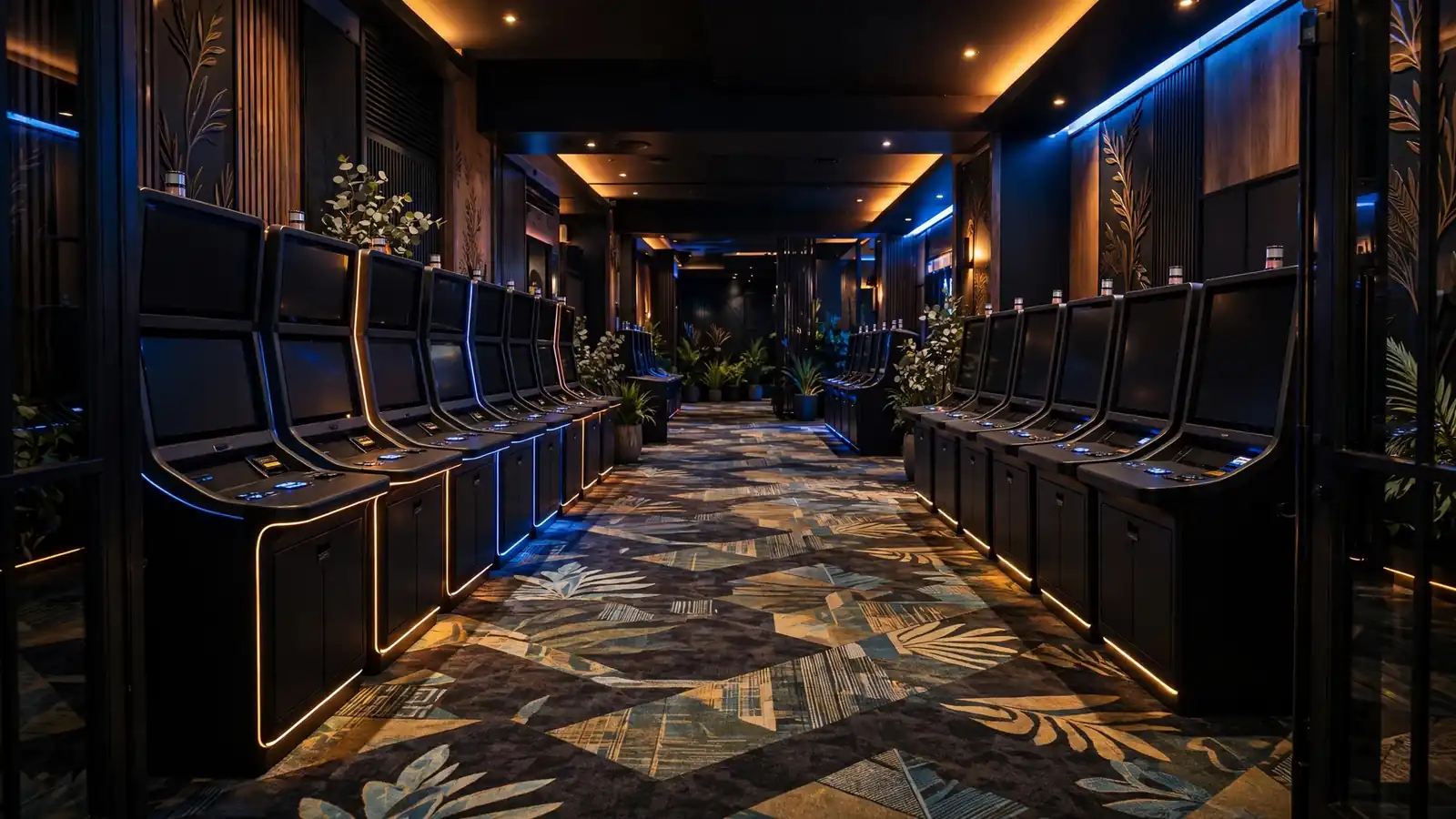
“Pokies parlour” is an informal expression, not a single national legal category for Australian venues. It can suggest a place centred on poker machines, but the phrase alone does not establish whether a venue is a full-scale casino, another kind of gaming venue, or simply a business using promotional wording. The distinction matters: a name can describe an atmosphere or a product without identifying the venue’s licence or regulatory status.
A full-scale casino is a specific kind of licensed property. In Australia, casino regulation sits with state and territory jurisdictions, and each casino operates under a licence issued by the jurisdiction where it is located. There is therefore no single national casino licence that turns every venue advertising pokies into a casino. The relevant question is what kind of property it is and which local jurisdiction regulates it, not whether its name contains “parlour” or “casino”.
The phrase is often used loosely because “pokies” is familiar shorthand for gaming machines, while “parlour” can imply a dedicated room or venue. But combining those words does not create a reliable classification. A gaming venue and a full-scale casino are not interchangeable labels. A venue may be associated with gaming without being a casino; conversely, a casino is defined by its licensed status, not by whether someone describes it as a pokies parlour.
Choosing a pokies parlour casino in Australia means weighing the available licensing and payment information before deciding where to play. This shortlist offers a concise reference to the details provided for each operator.
7Bit Casino
7Bit Casino is operated by Dama N.V. and holds a Curaçao licence. These are the available identifying details for this listing.
Wild Tokyo
Wild Tokyo lists a Curaçao licence and a minimum deposit of A$10. Its stated payout times are 30–60 minutes for crypto and 1–5 days for fiat.
SkyCrown
SkyCrown is licensed by the Tobique Gaming Commission. The listed payout times are around 10–15 minutes for crypto and 1–5 days for fiat, with a A$30 minimum deposit.
Neospin
Neospin is listed with Curaçao Gaming Control Board licence OGL/2023/176/0095, held by Hollycorn N.V. That licensing information is the available detail for this listing.
Uptown Pokies
Uptown Pokies is listed as operating since 2017 under a Curaçao licence. Its stated minimum deposit is A$20.
WinSpirit Casino
WinSpirit Casino holds Curaçao eGaming licence OGL/2024/923/0383 through Antillephone N.V. The listed minimum deposit is A$30.
DragonSlots Casino
DragonSlots Casino is listed under the Curaçao Gaming Authority, with Jumpman Gaming Ltd identified as the operator. These are the available details for this listing.
Thor Casino
Thor Casino is listed under a Curaçao licence associated with Antillephone N.V. and Versus Odds B.V. Its stated minimum deposit is EUR 20.
Vegaz Casino
Vegaz Casino is listed with Curaçao licence OGL/2024/1335/0780 and a minimum deposit of EUR 20. These details provide the available reference points for the operator.
LuckyVibe
LuckyVibe is listed with Curaçao Gaming Control Board licence OGL/2023/176/0095, held by Hollycorn N.V. That licence is the available identifying detail.
This distinction also limits what can be inferred from a machine count. A specialist review has reported more than 20 full-scale casinos across Australia, describing coverage across all states. That is a report attributed to that type of source, not a permanent national register: the number of properties can change, and the phrase “pokies parlour” does not add another confirmed casino to the count. It is more useful as a rough description of the market’s scale than as a legal or operational definition.
For the same reason, the national figure for casino gaming machines should not be treated as a count of every poker machine in every Australian venue. The reported total is 3,308 machines installed in casinos and endorsed on their venue licences. Its scope is casinos. It does not establish the number of machines in other kinds of gaming venues, nor does it show that every venue using “pokies” in its description belongs to the casino sector.
A careful reading separates three things that promotional language can blend together: the type of property, the activity associated with it, and the licence under which it operates. “Pokies” points towards gaming machines. “Parlour” suggests a setting. “Casino” has a more specific meaning when attached to a property licensed by its state or territory jurisdiction. Only the last of these, supported by the relevant licensing status, identifies a full-scale casino.
That is why “pokies parlour casino” should be read as a phrase requiring clarification, rather than as a formal venue class. It may be used to describe a casino with gaming machines, or it may be a loose label for a different gaming venue. Without the property’s identity and jurisdictional licence, the wording does not settle which. A polished name is not a regulatory instrument.
The distinction is practical, not merely linguistic. Casino figures relate to licensed casino properties; broader references to gaming venues cover a wider category. Mixing those groups produces misleading comparisons, particularly when machine totals or national counts are presented without saying what they include. The first check is therefore the category being counted. If the subject is casinos, the count should refer to casino properties or machines installed in casinos, rather than to every venue where gaming may occur.
In Australia, then, “pokies parlour” works as everyday descriptive language, not as proof that a location is a casino. The casino category is anchored to a local licence; the parlour wording is not. Keeping those meanings separate gives the phrase a usable scope without turning a casual label into a claim about the venue’s legal standing.
Australia’s gambling map is not confined to capital cities. A specialist gambling review counts facilities in 147 Australian cities, a snapshot that includes urban and regional centres. The figure describes the review’s coverage rather than a fixed national register: venue classifications and listings can change, so a city count should be read as a dated inventory, not a permanent measure of the market.
A specialist gambling review identifies facilities in 147 Australian cities, though this should be read as a dated inventory rather than a permanent national register.
The same review identifies Sydney, New South Wales, as the country’s largest gambling city, listing 11 facilities there. That concentration makes Sydney a clear point of comparison in the review’s geography. It does not mean that the rest of the country is organised around a similar pattern. A count of facilities in one city says nothing by itself about their size, type, licensing arrangements or the range of gambling available at each location.
The Northern Territory presents a different pattern in the review: three casinos across three cities. Alice Springs is listed as the Territory’s city with the most casinos, at one. In other words, it leads the Territory’s city-level count without having multiple casinos itself. The distinction matters because “largest” can refer to different measures: the review’s description concerns the number of casinos by city, not the scale of a venue or the amount of gambling activity.
Taken together, the Sydney and Northern Territory figures show why a national total alone can obscure local distribution. Sydney is a city-level concentration, while the Territory’s casinos are spread across separate centres. Neither example supports treating all Australian locations as equivalent or assuming that a regional centre has the same kind of facility as a capital.
These figures should also be kept within their stated scope. “Gambling facilities” is a broader category than casinos, so the count of cities with gambling should not be read as a count of cities with a full-scale casino. Conversely, the Northern Territory figure specifically concerns casinos. Mixing those measures would produce a misleading comparison: one is a broad geographic count, the other a casino count across cities.
For an Australian casino geography overview, the practical distinction is between presence and concentration. A facility may appear in a city-level inventory without making that city a casino centre, while a high city count signals concentration only within the measure used by the review. The numbers are useful for orientation, but they are not interchangeable and should not be turned into a definitive ranking of every state, territory or regional destination.
A venue’s address, operating schedule and admission rules are more useful for planning a visit than the label “pokies parlour”. Major Australian casinos operate around the clock, so a late-night or early-morning visit is possible. That does not establish that every restaurant, entertainment area or service within a property keeps the same hours; those details are venue-specific.
Several locations illustrate the different settings. Lasseters Casino is at 93 Barrett Drive in Alice Springs, Northern Territory. Jupiters Gold Coast Casino & Hotel sits on Broadbeach Island on the Gold Coast. Country Club Casino is at Country Club Avenue in Prospect, within Meander Valley.
The nationwide minimum age for casino entry is 18. Major casinos also require valid photo identification for entry. The age threshold is a baseline for admission to the casino, not a statement about access to every other facility on a property. Venue-specific conditions may apply to restaurants or entertainment areas, so casino entry rules should not be treated as a blanket description of the whole site.
Located at 93 Barrett Drive in Alice Springs, Northern Territory.
Located on Broadbeach Island on the Gold Coast.
Located at Country Club Avenue in Prospect, within Meander Valley.
For a practical visit, the distinction is straightforward: the casino floor at a major property operates 24 hours, while the address identifies where that property is located. A property can be open while a particular facility within it follows a different schedule.
A site’s availability from an Australian connection is not evidence that it holds an Australian online-casino licence. The same applies if a site accepts account traffic or appears at a different web address. Those details describe access, not legal status. Under the Interactive Gambling Act 2001, operators must not provide real-money online casino games to people located in Australia. The prohibition covers casino-style services such as slots, poker, blackjack and roulette.
That distinction matters when an online service is described as a digital version of a physical pokies parlour. Similar branding or game imagery does not make the online service equivalent to a licensed casino venue. Australian casinos operate under licences issued by their respective state or territory jurisdictions; that venue-based licensing arrangement does not create a local licence for an offshore website. Nor does a domain name, an account page or a functioning sign-in process establish one.
The real-money question is therefore not settled by whether a website loads, whether registration appears possible, or whether a service advertises deposits and withdrawals. The relevant legal issue is whether an operator provides prohibited interactive gambling to people in Australia. Online casino games offered for real money fall within that prohibited category. A site may present itself as available, but presentation and availability do not alter the rule.
A “free play” label also needs to be read precisely. It may describe how a page characterises an activity, but the label alone does not establish the service’s legal status or the conditions attached to an account. Free wording should not be treated as proof that a service is authorised, nor should it be confused with a finding that a real-money casino service is lawful. The distinction is between the claims made by a website and the service it actually provides.
The Australian Communications and Media Authority (ACMA) is the federal body responsible for enforcing the Interactive Gambling Act and monitoring compliance with federal interactive-gambling rules. It can investigate operators that provide or advertise prohibited services and can ask Australian internet service providers to block access to websites that offer those services or promote them in Australia. Blocking is an enforcement measure, not a licensing system: a blocked address does not become the only address associated with a service, and a reachable address does not become approved.
ACMA has taken blocking action against illegal gambling services, including alternate domains associated with Fair Go. A specialist review has also discussed Fair Go-related addresses in the context of changing access. That is a report about domain activity, not proof that the service is licensed in Australia. It does not establish that BetStop blocks access to Fair Go, and it should not be read as evidence that Fair Go is an Australian-licensed wagering provider.
Legal Prohibition
Under the Interactive Gambling Act 2001, operators must not provide real-money online casino games to people located in Australia.
When an address is blocked, the practical effect can be that it no longer resolves through an Australian internet provider. Services may then appear at other addresses, whether through a change of domain or another route to the same website. The address changing over time can make access inconsistent, but it does not change the underlying legal position. An alternate domain is not a substitute for Australian authorisation.
ACMA’s published enforcement figures illustrate the scale of its blocking work. It has blocked more than 1,455 illegal gambling and affiliate websites since November 2019 following enforcement action. The reported number of illegal services that have withdrawn from the Australian market since 2017 is not consistent across accounts: one figure is more than 210, while another is more than 190. Both describe withdrawals, not licences granted, and neither turns a website’s current availability into evidence of legality.
The practical conclusion is narrow. Online access, an account interface, an alternate address and a “free” label are not licensing credentials. Real-money online casino games provided to people in Australia are prohibited under federal law, while ACMA can pursue enforcement against operators and advertising and seek website blocks. A domain that remains reachable after enforcement, or a replacement domain that appears later, does not reverse that status.
For a physical venue, the relevant licence belongs to the property and its state or territory jurisdiction. For an online casino-style service, the legal framework is different: the Interactive Gambling Act prohibits operators from supplying real-money casino games to customers in Australia. Treating the two settings as interchangeable obscures the central issue. A familiar venue name or a polished online presentation does not transfer a land-based licence to an internet service.
A sign-up bonus, a no-deposit offer, free chips or free spins are promotional labels, not complete terms. Each describes a possible inducement, but none establishes who is making the offer, what activity it applies to, or whether it is lawful to provide in Australia. A headline cannot settle those questions. The operative terms and the legal status of the service have to be considered together.
For an Australian audience, that distinction is decisive for online casino promotions. The Interactive Gambling Act 2001 prohibits operators from providing real-money online casino games to people in Australia. Advertising real-money online casinos to Australian audiences is also prohibited. A bonus headline therefore cannot be treated as evidence of a lawful Australian online casino offer, and a description such as “free” does not alter the character of the service behind it.
The wording can still look precise while leaving the important conditions unresolved. “No deposit” may suggest that no initial payment is needed, but the phrase alone says nothing about eligibility, required account activity, withdrawal conditions or whether the promotion is available to people in Australia. “Free chips” identifies a promotional unit, not its cash value. “Free spins” describes an advertised feature, not a verified entitlement or a permissible offer. Without complete, applicable terms, none of those labels produces a reliable final amount.
A promotion is a set of conditions, not a number printed in large type. Even where a headline states a bonus amount, that amount does not by itself show what can be withdrawn, what must be done first, or whether the offer applies to a particular person. The practical value depends on the full conditions and on whether the offer can lawfully be made available to the intended audience.
The same applies to a claimed deposit match. A percentage or matching figure, if advertised, would describe only one part of the arrangement. It would not establish the qualifying deposit, the maximum benefit, any required activity, or the circumstances in which funds could be withdrawn. Those details cannot be inferred from the word “bonus”. Nor should an attractive headline be converted into a cash value by assuming conditions that have not been stated.
A no-deposit sign-up promotion makes the distinction especially visible. “No deposit” addresses one possible entry condition; it does not establish that the funds are cash, that they can be withdrawn, or that the promotion is open to Australian residents. A free-chip claim raises the same accounting question: what does the chip represent, and under what conditions, if any, does it become withdrawable money? The phrase itself answers neither.
Free spins are also a promotional description rather than proof of a cash entitlement. The number displayed, where one is displayed, would not alone determine a final value. The value would depend on the applicable terms and the legal availability of the underlying service. In Australia, promotional language cannot make prohibited real-money casino activity lawful.
This is why an offer should not be assessed by its largest headline figure. A headline is not a settlement statement. The material points are the service being promoted, the jurisdiction in which it is offered, the terms that govern it and the final amount that those terms make available. If those points cannot be established, a claimed benefit cannot sensibly be counted as money.
In ordinary commercial language, “free” can mean that no payment is required at one particular stage. It does not necessarily mean there are no other conditions, or that the item has an equivalent cash value. A free chip might be a promotional credit rather than withdrawable money; a free-spin claim might carry conditions attached to its use or any resulting balance. Those are distinctions that complete terms would need to resolve, not details that can be supplied by the label.
The accounting test is straightforward: identify what is received, what conditions attach to it, and what amount can ultimately be withdrawn. A promotional balance that cannot be withdrawn is not equivalent to cash. A stated benefit subject to unstated or inaccessible conditions cannot be assigned a dependable final value. Where a claim does not establish those elements, the prudent description is simply that it is a claim, not a confirmed cash benefit.
That reasoning does not endorse or invite participation. It explains why promotional wording is insufficient to prove value. In the Australian online casino context, the legal position comes first: operators may not provide real-money online casino games to people in Australia, and such services may not be advertised to Australian audiences. A detailed set of terms would not override that prohibition.
The Australian Communications and Media Authority, or ACMA, oversees compliance with federal interactive-gambling rules and enforces the Interactive Gambling Act 2001. It can ask Australian internet service providers to block websites that provide prohibited interactive gambling services or advertise them in Australia. A promotional page is therefore not separate from the service it promotes: advertising a prohibited service can itself fall within the regulatory concern.
ACMA reports that enforcement actions have led to more than 1,455 illegal gambling and affiliate websites being blocked since November 2019. That figure concerns enforcement activity, not the quality or value of a bonus. It does, however, make clear why a promotion appearing online should not be treated as a settled commercial offer merely because its wording is visible.
There is a reported discrepancy in the count of illegal services that have left the Australian market since ACMA began enforcing the rules in 2017. One version gives a figure of more than 210; another gives more than 190. Those figures should not be silently collapsed into a single count. Neither count establishes whether a particular bonus is genuine, available or lawful.
A promotion may remain visible even as enforcement changes access to websites or services. Visibility is not regulatory approval. Nor does a polished presentation establish that an operator is entitled to provide the underlying activity in Australia. For an offer involving real-money online casino games, the governing prohibition remains the relevant point; marketing language does not create an exception.
This distinction also prevents a common category error. A website can display a sign-up message, a free-chip claim or a “no deposit” headline without establishing that the promotion is an authorised Australian casino offer. The claim and the lawfulness of the underlying service are separate questions. Counting a promised bonus as a benefit before answering the latter question mistakes advertising for evidence.
“Sign-up bonus” usually signals a benefit framed around account registration. The phrase alone does not define the qualifying audience, the associated conditions or the value that could ultimately be withdrawn. In Australia, if the sign-up message promotes real-money online casino games, the issue is not merely whether the terms are clear: the service and its advertising are prohibited.
“No-deposit bonus” narrows the headline to an asserted lack of an initial deposit. It does not establish that there are no other requirements, that funds are withdrawable, or that the offer is lawful for an Australian audience. A claim can be called no-deposit and still fail to establish any final cash benefit.
“Free chips” and “free spins” are similarly incomplete descriptions. They do not independently demonstrate a cash equivalent, a right to withdraw, or a valid Australian offer. Promotional units are not a substitute for a clear statement of what is payable. Where the underlying promotion relates to prohibited online casino activity, examining a claimed benefit does not make that activity permissible.
A “casino free” claim can be even less informative because it may refer to several different things: an advertised promotional credit, a no-cost trial, or merely language intended to attract attention. The words do not identify the service’s legal status or establish a monetary value. Treating every use of “free” as a cash offer would be an accounting error, not a generous interpretation.
The same discipline applies to a “pokies parlour bonus” claim. The wording can refer to a promotion associated with a venue, an online offer using familiar venue language, or a general marketing statement. The label alone does not settle which one it is. For online promotions involving real-money casino games, the Australian prohibition still applies; for any other claim, the actual service and conditions would have to be identified before the wording could be given a definite meaning.
Promotional copy tends to foreground what may be credited and background what may restrict access to it. A sound comparison would require a defined starting condition, the complete terms, and a final withdrawable amount. Without those, a headline figure is not a net benefit. It is simply a headline.
The calculation should not fill gaps with optimistic assumptions. If a promotion does not state what happens to a promotional balance, its cash value cannot be inferred. If conditions are unclear, they cannot be treated as satisfied. If the offer is not lawfully available to the intended audience, an apparent benefit cannot be counted as an available return. These are separate checks, and passing one does not pass the others.
This matters particularly where “no deposit” is presented as though it removes all cost or risk. It describes only the deposit wording. It does not prove that no other conditions apply, nor that any amount can be withdrawn. Likewise, “free” does not mean cash, and a sign-up label does not establish eligibility. The difference between an advertised amount and a final payable amount is precisely where the terms matter.
There is no responsible way to turn an unspecified promotion into a monetary comparison. A particular amount, bonus structure or final payout cannot be asserted without terms that establish it. In the case of online casino promotions aimed at people in Australia, even complete terms would not overcome the legal restriction on providing or advertising the service.
The useful conclusion is narrow: bonus language identifies a marketing claim, not a verified Australian entitlement. “No deposit”, “free chips”, “free spins” and “sign-up bonus” do not establish an amount that can be treated as cash, and they do not change the legal status of the underlying service. The arithmetic begins only after the conditions and lawful availability are established; the headline comes first because it is designed to.
A useful review separates observable details from judgement. A named venue and a location can be checked; descriptions such as “excellent atmosphere” or “great experience” are opinions unless the reviewer explains what they refer to. Treating both kinds of statement as equivalent makes a review sound more conclusive than it is.
Reading a Review
Identify the basics
Verify the venue's identity and its specific location to ensure a checkable anchor.
Separate impressions
Distinguish personal opinions, such as "excellent atmosphere," from observable facts.
Evaluate details
Check if practical claims, like "convenient," are supported by specific explanations rather than adjectives.
Verify scope
Ensure the review describes a specific venue rather than making general claims about all Australian gaming venues.
Start with the venue’s identity and location. Lasseters Casino is at 93 Barrett Drive in Alice Springs, Northern Territory, with the postcode 0870. Jupiters Gold Coast Casino & Hotel is on Broadbeach Island on the Gold Coast. Country Club Casino’s address is given as Country Club Avenue, Prospect, in Meander Valley. These references make a review more specific: a reader can tell which place is being discussed and whether a location claim matches the named venue.
Then separate venue facts from personal impressions. A review may report what the reviewer saw or experienced, but that does not turn a preference into a measurable feature. “Quiet” may describe one visit; it does not establish a general condition. A claim about a particular facility or service is more informative when it says precisely what was observed, rather than relying on a broad rating or a string of promotional adjectives.
The same distinction applies to practical details. A review that names a location gives a concrete point of reference. A review that simply says a parlour is “convenient” leaves the basis unclear. The word could refer to where the venue is, how it is reached, or something else entirely. Without a specific explanation, the claim has little value for comparing venues.
Check whether the review keeps its scope clear. A description of one casino should not be read as a description of every gaming venue in Australia. Nor does a favourable account establish that every visitor will have the same experience. Reviews are records of claims and observations, not guarantees of future conditions.
Ratings can be useful as summaries, but the underlying explanation matters more. A score without reasons does not show whether it reflects the location, the reviewer’s preferences, or a particular visit. A detailed account allows those elements to be judged separately. Where the review provides no basis for a conclusion, the rating is packaging rather than evidence.
A careful reader can therefore assess a pokies parlour casino review by asking what is directly identifiable, what is reported as an observation, and what is merely an evaluation. Named locations provide a checkable anchor; adjectives and scores need supporting detail. That approach does not require a review to be neutral. It requires its claims to be distinguishable from its opinions.
“VIP” is a label, not an entry rule. A venue may use it to describe a membership category, a service tier or a promotional identity, but the wording alone does not establish what access or benefits are provided. It also does not create an exception to the age requirement for casino entry.
The national baseline is straightforward: casino entry in Australia is restricted to people aged 18 and over. VIP status does not lower that threshold. Claims suggesting that a special invitation, membership or hosted arrangement allows younger guests into casino gaming areas should therefore be read separately from the standard entry rule; the label itself proves no such exception.
A useful distinction is between a benefit being described and a condition being evidenced. “Priority access” or “exclusive service” may sound concrete, but without stated terms they leave basic questions unresolved: what the benefit covers, who qualifies and whether it applies to casino entry at all. None of those phrases changes the legal age baseline. The arithmetic is uncomplicated; the packaging is where ambiguity tends to collect.
The same care applies to the phrase “VIP parlour casino.” It may describe branding or a claimed level of service, but it is not a separate class of casino with a different nationwide entry age. A credible statement about VIP access should identify the actual condition attached to it, rather than relying on status language to imply a privilege. Where no condition is stated, no particular benefit can be inferred.
Age and VIP claims are therefore separate matters. The age threshold is fixed at 18 for casino entry across Australia; VIP wording, by itself, establishes neither additional access nor a change to that threshold.