Major Australian casinos operate around the clock, but that does not verify entry, entrance access or individual services at a specific property.
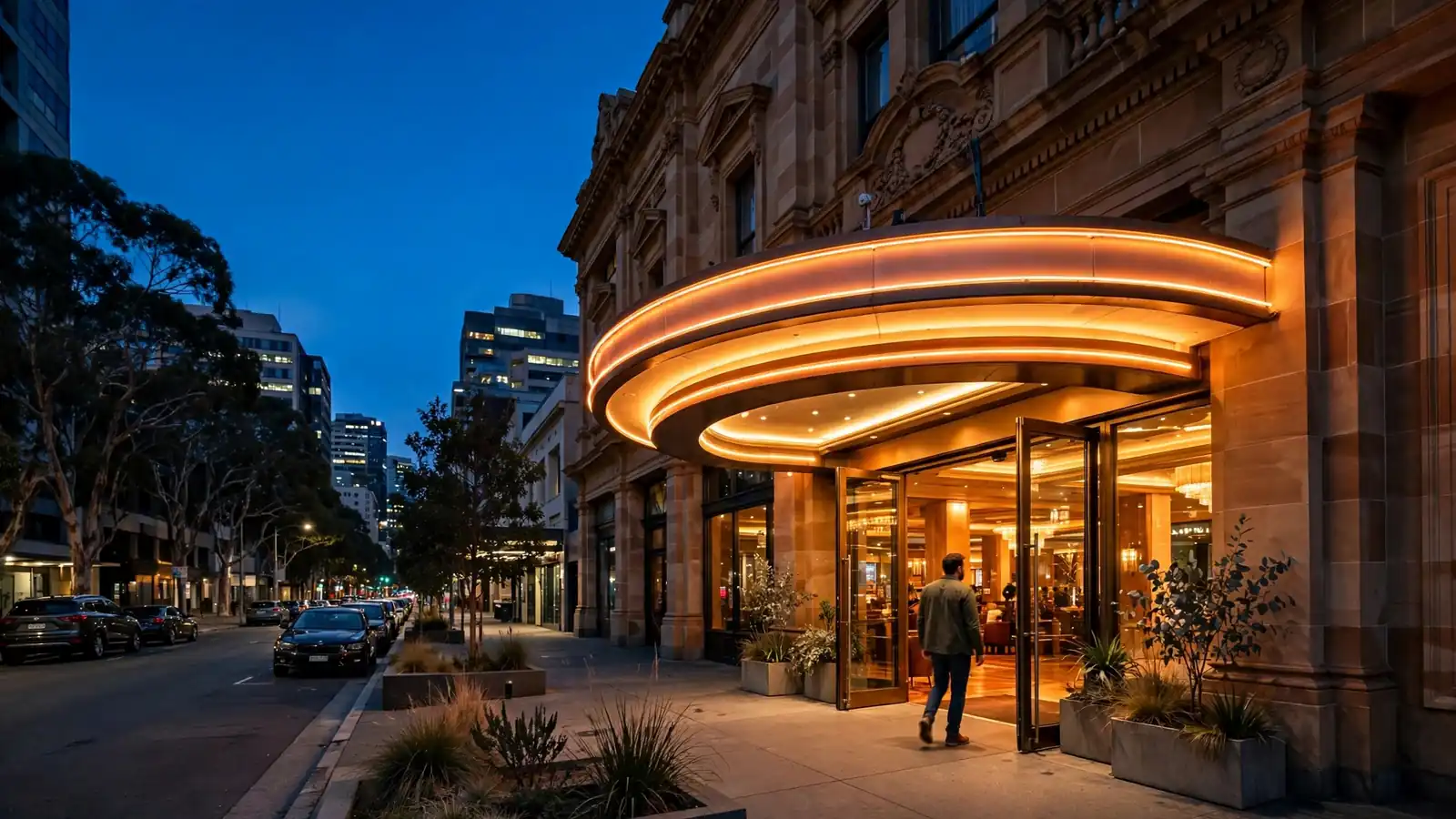
An “open now” result can answer a narrow question: a location appears to be operating at the time the result is displayed. It does not, on its own, confirm that a particular gaming venue is accessible for the intended visit. Operating status, entry conditions and the accuracy of a location listing are separate matters.
All major Australian casinos operate around the clock. That is useful context for someone looking for a casino at an unusual hour, but it is not a live confirmation of access to a specific property. A broad statement about major casinos cannot establish whether a particular entrance is open, whether the venue is admitting visitors at that moment, or whether a service within the property is available. “Open” is not a single switch covering every part of a large venue.
A location search also works with the information attached to a place listing. The result may show a status, address or estimated distance, but those details do not amount to a direct check of conditions at the entrance. Listings can be incomplete or out of date; a map pin can identify a property without showing which entrance is in use. A result that looks current is still a result, not confirmation from the venue.
Looking for pokies open near you in Australia in 2026? This list offers a quick reference to operators with the available licensing and payment details, so you can check the basics before deciding where to play.
7Bit Casino
7Bit Casino is operated by Dama N.V. and holds a Curacao license.
Wild Tokyo
Wild Tokyo has a Curacao license and a minimum deposit of A$10. Its stated payout times are 30–60 minutes for crypto and 1–5 days for fiat.
SkyCrown
SkyCrown is licensed by the Tobique Gaming Commission. Its stated payout times are around 10–15 minutes for crypto and 1–5 days for fiat, with a minimum deposit of A$30.
Neospin
Neospin holds Curacao Gaming Control Board license OGL/2023/176/0095, issued to Hollycorn N.V.
Uptown Pokies
Uptown Pokies has operated since 2017 under a Curacao license and has a minimum deposit of A$20.
WinSpirit Casino
WinSpirit Casino holds Curacao eGaming license OGL/2024/923/0383, issued to Antillephone N.V. Its minimum deposit is A$30.
DragonSlots Casino
DragonSlots Casino is licensed by the Curacao Gaming Authority, with Jumpman Gaming Ltd named as the operator.
Thor Casino
Thor Casino holds a Curacao license associated with Antillephone N.V. and Versus Odds B.V. Its minimum deposit is EUR 20.
Vegaz Casino
Vegaz Casino holds Curacao license OGL/2024/1335/0780 and has a minimum deposit of EUR 20.
LuckyVibe
LuckyVibe holds Curacao Gaming Control Board license OGL/2023/176/0095, issued to Hollycorn N.V.
The distinction matters especially when a search combines different kinds of places. A person looking for pokies nearby may see gaming pubs, clubs or casinos grouped together, even though they are not interchangeable. A result for a pub does not establish the operating status of a casino, and a casino listing does not confirm that a different gaming venue is open. The category shown in a map or directory can be broad, so the name and address need to match the actual destination.
“Near me” is also relative. The search engine estimates proximity using the location information available to it, and the first result is not necessarily the closest practical destination. Distance on a map does not include the time or route required to reach an entrance, nor does it tell whether the venue is accessible from the side of the property shown. If location access is unavailable or imprecise, results may be ordered using a general area rather than the person’s exact position.
That makes a nearby result a starting point, not a promise that the destination is both open and convenient. A place can appear close while being on the other side of a large site or in a part of town that is not straightforward to reach. The search can identify a location; it cannot settle every question about access.
Entry rules add another layer. The minimum age for entry to an Australian casino is 18, and valid photo identification is required for entry to all major Australian casinos. A listing marked open does not confirm that a person meets entry requirements or that acceptable identification is available. Those conditions apply even when the venue is operating. In practical terms, the displayed status and the ability to enter are different checks.
Search wording such as “open now” may also be based on a venue’s general hours rather than a live update. That can make a status useful for screening out an obviously unsuitable result, but not sufficient as the final check before travelling. The time shown on a listing is not necessarily the time at which the venue last confirmed its status. A current clock and a current status label are not the same thing.
A more reliable assessment separates three questions: what type of venue the result identifies, whether the address matches the intended destination, and whether current access has been confirmed. These checks prevent the common error of treating a broad nearby result as a confirmed invitation to enter. For a specific visit, the venue’s own current information is more relevant than a generic map label, particularly where entry arrangements or access points may differ.
The phrase “pokies open near me now” can therefore refer to several different things: a search for a casino, a search for another gaming venue, or simply a request for a place that appears to be operating nearby. Those meanings produce different results. The wording alone does not establish which kind of venue is wanted, and the returned list may not resolve that distinction.
The useful conclusion is limited but clear: major Australian casinos operate 24 hours a day, while a particular result marked “open” does not verify every detail of access at that property. A nearby listing identifies a possible destination. Its category, address, entry requirements and current status remain distinct pieces of information.
All major Australian casinos operate around the clock. That is a statement about the operating hours of major casino properties as a whole. It is not a guarantee that every gaming area, machine, entrance, restaurant or other facility within a property is available at every hour.
That distinction matters when a planned visit depends on a particular activity. A casino may be operating while access to a particular part of it is subject to separate arrangements. The general 24-hour description does not specify those arrangements. It therefore cannot settle whether a particular gaming area is available at six in the morning, seven in the morning or late at night.
Nor does the statement extend automatically to every casino or gaming venue in Australia. “All major casinos” is a defined scope, not another way of saying every property that offers gambling. A general national description cannot establish the hours of a smaller or otherwise different venue. Treating it as universal would turn a qualified statement into an unsupported one.
A request for a casino that is open at a particular hour contains two separate questions: whether the property is operating, and whether the intended facility within it is accessible then. The 24-hour information addresses the first question for major casinos. It does not answer the second.
The same limit applies to searches for gaming facilities open at six or seven in the morning, at eight in the morning, or until five or six in the morning. These are specific time checks. The broad operating-hours fact does not provide a schedule for individual facilities or show that a particular venue’s arrangements match the time requested.
A property operating continuously also does not mean that every service within it runs continuously. The term “casino hours” can describe the property without specifying each component’s hours. Those are different units of information; combining them produces a more confident answer, not a more accurate one.
Australian casinos are regulated by their state or territory. Each property operates under a licence issued by the jurisdiction where it is located. The national statement about major casinos operating 24 hours does not replace those property-level arrangements or make the hours of one property applicable to another.
This is also why a time stated for one casino should not be transferred to a different venue. A licence belongs to a property under its local jurisdiction; a national summary is not an individual timetable. General hours provide context, while the relevant venue’s own current information is needed for a precise facility-level schedule.
Major Australian casinos are regulated by their state or territory, and each operates under a licence issued by that specific jurisdiction.
The practical consequence is straightforward: the 24-hour description is useful for understanding the broad operating pattern of major casinos, but it is not a minute-by-minute access record. If the visit depends on a specific area being open at a specific time, that point needs to be checked against the venue’s own information. The broad fact alone cannot supply it.
There is a useful difference between “the casino operates 24 hours” and “the facility needed for this visit is available 24 hours.” The first is supported as a general description of major Australian casinos. The second is more specific and cannot be inferred from the first.
That distinction prevents two common errors. One is applying the major-casino statement to every gambling venue. The other is assuming that continuous property operation guarantees access to every component. Neither follows from the stated hours.
For an early-morning or overnight visit, the relevant question is not only whether a major casino operates around the clock. It is whether the intended part of that particular property is accessible at the planned time. Without that separate detail, the broad statement should remain broad. A clock time can narrow a visit plan; it cannot turn general operating information into a facility-level schedule.
Good Friday opening cannot be inferred from a casino’s ordinary schedule. A venue may operate through the year, but that does not establish whether its gaming floor, entrances or other facilities are accessible on a particular public holiday. The holiday’s name is not an operating-hours notice.
The same distinction applies to a visit planned for today. A general statement about a casino’s hours describes its usual operating position; it does not confirm that the venue is open at the time of checking. Nor does it settle whether a particular part of the property is available. “Open tonight” is therefore not a single fact unless it is tied to a named venue, a date and the facility in question.
Australia has casino venues across all eight states. One specialist review counts more than twenty full-scale casinos nationally, but a national count cannot determine a local holiday schedule. The relevant condition is the venue’s own notice for the date concerned. Statewide assumptions are not a substitute for that notice.
For Good Friday, confirmation needs to be explicitly holiday-specific. A standard hours page may remain useful for ordinary days, but unless it addresses the holiday, it cannot settle the question. A separate notice may specify changed access or hours; where no such notice is available, the schedule remains unconfirmed rather than automatically open or closed. Guessing from the normal weekly pattern adds no reliable information.
For today, the date and time matter. A notice for a previous day does not confirm current access, and a page showing ordinary hours may not reflect a temporary change. A current venue announcement or direct confirmation is stronger evidence than an old listing copied across multiple directories. The distinction is practical: a venue can have an established operating schedule while the status of a particular visit remains unsettled.
Holiday Hours
Standard hours pages do not establish access for public holidays; venue-level confirmation is required for dates like Good Friday.
A useful check is narrow rather than broad: identify the exact casino, then look for a notice that names Good Friday or the current date and makes clear which areas it covers. If the information only describes general hours, it answers a different question. If it is unclear whether the notice applies to the gaming floor or to the wider property, that uncertainty should be resolved before travelling.
This matters especially when “near me” is part of the intended visit. Proximity identifies a possible destination, not its holiday status. Search results may surface nearby properties or standard business information, but neither proximity nor a listing label confirms entry on Good Friday. The distance calculation and the opening-hours calculation are separate.
A careful reading also separates “open” from “available for the intended visit.” A property might publish hours for one facility without confirming every area, or a holiday notice might state a special arrangement without describing all access details. The wording of the notice determines what it actually confirms; anything beyond that is an assumption.
For a visit tonight, the same standard applies even when the day is not a public holiday. “Today” changes with the calendar, and an evening plan depends on current information rather than an undated summary. A listing that once showed a schedule is not evidence that the schedule still applies. If no date-specific confirmation can be found, the defensible answer is that opening has not been confirmed—not that every casino nearby follows one common rule.
Good Friday and an ordinary day should therefore be treated as separate cases. The general operating picture supplies context, but only a venue-level notice tied to the relevant date can establish the status of a particular visit.
“Nearest” is a distance question, not a confirmation that a venue is open or accessible at the time of arrival. A result can be close to a chosen address while still requiring a separate check of its entrance, current operating arrangements and route. The starting point matters too: a search centred on a suburb, a workplace or a transport stop can produce different results.
Australia’s gaming venues are spread across a large area, so proximity has a different meaning in a city with several listed facilities than in a regional location. A specialist gambling-location review reports 147 Australian cities with gambling facilities. That figure describes the review’s coverage, not a guarantee that every city has a casino or that every listed facility is a casino. Sydney is identified in the same type of review as the country’s largest gambling city, with 11 gambling facilities. A city-level count still does not establish which facility is nearest to a particular address.
This distinction matters for places such as Redcliffe. A location-based result for Redcliffe may identify facilities within a selected radius or across a broader area, depending on the map’s settings and the location used. It does not, by itself, establish that a result is a casino, that it is open, or that it can be reached conveniently from the actual starting point. The map pin is a location claim; opening status is a separate claim.
Practical Visit Check
Identify venue
Determine the exact casino and its address to ensure it matches the planned route.
Verify hours
Check a venue-controlled source for current operating hours and specific access for the intended visit time.
Confirm entry
Ensure you have valid photo identification and meet the minimum age requirement of 18.
“Early” adds a time condition but does not change the distance calculation. A venue may be the closest result without having the access arrangements required for an early visit. Conversely, a venue that suits the intended time may be farther away. General information about Australian casino operations cannot settle the opening status of a particular gaming venue at a particular hour. The useful comparison is therefore between a confirmed location and a confirmed time, rather than between map rankings alone.
A practical check has three parts: identify the exact venue, verify its current hours through a venue-controlled source, and confirm that the address and entrance match the route being planned. If public transport or a particular entrance is relevant, those details also need confirmation; a map’s estimated proximity does not establish access. For major Australian casinos, entry requires valid photo identification, and casino entry is limited to people aged 18 or older. Those conditions remain separate from whether the venue is nearby or open.
A result labelled “open today” is also not necessarily an answer to whether the venue is open at the intended early hour. “Today” covers the full day, while “early” refers to a narrower time. The relevant details are the venue’s stated hours for that date and any conditions on access. If those details are not available from a reliable venue source, the map result cannot fill the gap.
The same care applies to “closest” results. A ranking may use straight-line distance, a selected search area or an approximate location. None of those measures guarantees the shortest journey or confirms that the facility suits the intended visit. For a nearby casino visit, the final calculation is simple: distance identifies a candidate; current venue information determines whether that candidate fits the time and access requirements.
Yes. All major Australian casinos operate around the clock. That supports a qualified answer to whether a major casino can be open at any hour: its casino operation is continuous rather than confined to a daily opening window.
The qualification matters. “Open 24 hours” describes the casino’s operating schedule; it does not confirm that every part of a property is accessible throughout the day and night. A casino may sit within a larger venue, and the hours or entry arrangements for other facilities should not be inferred from the casino’s continuous operation. A result that labels a property as open all day is not, by itself, a guarantee about every entrance, service or area.
The same distinction applies to gaming machines. The general 24-hour fact concerns major casinos, not a promise that a particular machine, room or service will be available at every moment. Continuous operation is a property-level description, not a detailed schedule for each component.
This also sets a boundary on what “near me” can establish. Proximity and a 24-hour label can point to a relevant venue, but neither confirms the exact access arrangements for a planned visit. The practical question is not only whether the casino operates continuously; it is whether the intended point of entry and facility are available at that time. Those are separate details.
There is no basis for extending the general statement to every Australian venue. It applies to major casinos, not automatically to every gaming venue or establishment with gaming machines. Nor does it turn an online listing into confirmation of a particular property’s current arrangements. The wording should be read at the level it supports: major casinos operate 24 hours, while venue-specific access still requires its own confirmation.
Entry Requirements
Entry to all major Australian casinos requires valid photo identification and a minimum age of 18.
For anyone comparing “open now” with “open 24 hours,” the terms answer different questions. The former concerns present access; the latter describes continuous operating hours. A casino’s 24-hour operation can make it a possible option at any time, but it does not settle whether a specific service or access point is available when needed. That distinction is the useful answer: yes for major Australian casinos as a general operating pattern, not an unconditional guarantee about every venue feature.
A local result is only one part of the national picture. A specialist review reports more than 20 full-scale casinos across Australia, spread over all eight states. That is a source-specific count, not a permanent register: venue numbers and classifications can change, and a broad national figure cannot establish which property is nearest to a particular address.
Australia’s casino industry is regulated by state and territory authorities. Each property operates under a licence issued by its local jurisdiction, so licensing is tied to a physical venue and the rules of the jurisdiction where it is located. A listing in a map or directory can help identify a place, but its appearance in search results does not itself confirm the current status of that venue or its licence.
The distinction matters when a result leads to a website rather than a physical casino. An accessible page, an account screen that loads, or an alternate domain resolving in Australia is not evidence that the operator holds an Australian casino licence. Real-money online casino services are treated differently from land-based venues: under the Interactive Gambling Act 2001, operators cannot provide online casino games to people physically located in Australia.
The Australian Communications and Media Authority (ACMA) enforces that federal law and monitors compliance with interactive gambling rules. It can ask Australian internet service providers to block websites that provide prohibited interactive gambling services or advertise them in Australia. Blocking can affect whether a particular address loads, while alternate addresses may appear over time. Neither access nor non-access is a licensing test; the relevant issue is whether the service is lawful for the Australian market.
This leaves two separate questions behind a national or local result: whether a physical casino is listed near the relevant location, and whether an online service is legally permitted to offer casino games in Australia. A website’s appearance alongside land-based listings does not merge those categories. The search result may be a directory entry, an operator page, an advertisement or a different kind of gambling service; each needs to be understood on its own terms.
For a national view, the reported count gives scale, not a complete location guide. Australia’s eight-state spread means a result relevant in one part of the country may say little about access elsewhere. For licensing, the governing distinction is clearer: a land-based casino’s local licence does not authorise an online casino service, and a working website does not supply that missing authority.
Under the Interactive Gambling Act 2001, operators are prohibited from providing real-money online casino games to people physically located in Australia. The ACMA monitors compliance and can block non-compliant websites.
Late-night opening is a venue-level question, not a conclusion that follows from a broad description of casino operations. A major casino may operate around the clock, but that does not identify which property is nearby, whether its public areas are accessible at a particular hour, or whether a specific facility inside it is operating.
That distinction matters when a late visit depends on more than the casino floor. Entry, dining, entertainment and other services can have separate arrangements. A property’s general operating status therefore does not establish that every entrance or service is available throughout the night. Nor does a nearby result establish that the venue is currently admitting visitors.
The national machine count gives scale, not a local answer: 3,308 gaming machines are recorded as installed in Australian casinos under venue licences. That figure describes the sector as a whole. It cannot be used to infer how many machines are at a particular property, which facilities are open late, or which venue is the closest practical option.
Location also affects what “nearby” means. A result may be close by distance while still being inconvenient to reach, and a venue name in a late-opening result is not confirmation of its current access arrangements. The useful comparison is between the specific property and the actual visit: its location, its published operating information and the part of the venue intended to be visited.
Late-night claims should therefore be read narrowly. “Casino operates overnight” describes a broad operating pattern; it is not a promise that every nearby venue, service or entry point is available at the same time. A named shortlist would require current, venue-specific information rather than a sector-wide statement. Without that distinction, “open late” can sound precise while leaving the decisive detail unresolved.
A casino’s ordinary operating pattern does not, by itself, confirm whether its gaming areas will be accessible on Christmas Day. A venue may have a regular schedule, but the holiday date needs to be checked separately. “Open” can also refer to different parts of a property: access to the casino, hotel accommodation, restaurants or other facilities may not follow one shared timetable.
Australia’s casino industry is regulated by state and territory jurisdictions, and each property operates under a licence issued by its local jurisdiction. That arrangement makes the relevant venue the practical point of confirmation for a Christmas Day visit. A general description of Australian casino hours cannot establish a particular property’s holiday arrangements, and a result showing ordinary hours should not be treated as a Christmas schedule.
For searches about casinos open on Christmas Day nearby, the useful distinction is between a venue’s routine information and a date-specific notice. A current notice from the property, or direct confirmation from the venue, is more relevant than a directory entry that gives only standard hours. If the information does not clearly identify Christmas Day, it does not settle whether the casino itself will be accessible then.
The same caution applies when a property contains several facilities. An open hotel or restaurant does not necessarily establish that the casino is open, just as a casino’s status does not establish that every other service is operating. The relevant question is access to the particular area intended for the visit, on the holiday itself.
There is no single national Christmas Day schedule that can be inferred from the licensing structure. Conditions are attached to properties through their local jurisdictions; they do not turn a broad operating-hours statement into a holiday timetable. A nearby result can identify a venue, but proximity and ordinary hours are not confirmation of Christmas Day opening.
The defensible answer is therefore venue-specific: Christmas Day access must be confirmed for the individual property and facility. Without that confirmation, neither a listing nor the general picture of casino operations establishes that a nearby casino will be open.
A general statement that major Australian casino properties operate around the clock does not settle whether a particular gaming venue admits visitors on Anzac Day. A holiday can bring a separate operating schedule, and ordinary hours are not evidence that the same access arrangements apply on that date. Nor does a result showing a nearby venue establish that it will be open when needed.
The distinction is practical: continuous operation describes a broad pattern, while holiday access depends on the venue and the date. Anzac Day arrangements should therefore be checked against the specific property’s own current notice or confirmed directly with the venue. A schedule for another day, another property or another public holiday cannot be carried across as a substitute. There is no reliable calculation that turns a general-hours statement into a confirmed Anzac Day opening time.
Location adds a separate limit. A specialist casino directory lists three casinos across three Northern Territory cities and identifies Alice Springs as having one. That is a snapshot of a changing directory, not evidence that any particular venue there—or elsewhere—is open on Anzac Day. Proximity can narrow the location; it cannot supply a holiday schedule.
The same distinction applies to broad searches for nearby casinos. A venue may appear in a map or directory without that listing confirming holiday access. Before setting out, the relevant detail is the venue’s Anzac Day notice, not its standard hours or its position on a map. If no date-specific information is available, the opening status remains unconfirmed.
A nearby venue’s location, gaming-machine total and payment arrangements are separate facts. Australia has 3,308 gaming machines endorsed on venue licences and installed in casinos, but that national figure does not describe whether a particular venue handles cash or cheques, or how transactions are arranged there. Those details belong to the venue’s own operating information.
“Top rated” is also a comparison, not a property of a casino’s address or machine count. Without a stated rating method and comparable venue-level results, a superlative label cannot be treated as an objective measure. A list of locations or a total of installed machines does not establish which venue ranks highest.
The distinction matters online as well. A website loading, taking account traffic or appearing at a different web address does not establish that it is licensed to provide online casino services in Australia. The Interactive Gambling Act 2001 prohibits operators from providing real-money online casino games to people in Australia.
The Australian Communications and Media Authority (ACMA) enforces federal interactive gambling rules and can seek website blocking where prohibited services are provided or advertised. Following enforcement actions, it has blocked more than 1,455 illegal gambling and affiliate websites since November 2019. Reports of services withdrawing since enforcement began in 2017 give conflicting totals: one states more than 210, while another states over 190.
Website blocking can also affect which addresses resolve through Australian internet providers, and alternate domains may appear over time. Neither access to a site nor a changed address is evidence of Australian licensing. Physical casino details, payment facilities, comparative ratings and online regulatory status are distinct questions; one cannot be inferred from another.