Online gambling rules and land-based venue details are separate questions, from accommodation and dining to facilities.

The phrase “best casino in Western Australia 2026” can refer to a physical venue or to an online service. Those are different questions, and the rules for online casino games should not be read as a statement about the licensing or operation of a land-based casino.
The Interactive Gambling Act 2001 prohibits operators based in Australia from offering real-money online casino services to people in Australia. That restriction covers games such as pokies, blackjack and roulette. An Australian-run website therefore cannot lawfully provide those casino games to local players simply by describing itself as an online casino.
This distinction matters when terms such as “online casino in Western Australia” appear alongside searches about bingo, dining or parking. A search phrase does not establish that an online casino service is lawful, that a particular operator is Australian-based, or that a physical venue provides a particular facility. Dining, parking and other venue details need to be assessed separately from the rules governing online gambling.
Choosing a casino for Western Australia calls for a careful look at the details that are actually available, including licensing and practical payment information. Use these notes as a starting point and check current terms before signing up.
7Bit Casino
7Bit Casino is operated by Dama N.V. and holds a Curacao license.
Wild Tokyo
Wild Tokyo has a Curacao license and accepts deposits from A$10. Its stated payout times are 30–60 minutes for crypto and 1–5 days for fiat.
SkyCrown
SkyCrown is licensed by the Tobique Gaming Commission. Its stated payout times are around 10–15 minutes for crypto and 1–5 days for fiat, with a minimum deposit of A$30.
Neospin
Neospin holds Curacao Gaming Control Board license OGL/2023/176/0095, issued to Hollycorn N.V.
Uptown Pokies
Uptown Pokies has operated since 2017 and holds a Curacao license. Its minimum deposit is A$20.
WinSpirit Casino
WinSpirit Casino holds Curacao eGaming license OGL/2024/923/0383, issued to Antillephone N.V. Its minimum deposit is A$30.
DragonSlots Casino
DragonSlots Casino is licensed by the Curacao Gaming Authority, with Jumpman Gaming Ltd listed as the operator.
Thor Casino
Thor Casino is licensed in Curacao through Antillephone N.V., with Versus Odds B.V. listed as the operator. Its minimum deposit is EUR 20.
Vegaz Casino
Vegaz Casino holds Curacao license OGL/2024/1335/0780. Its minimum deposit is EUR 20.
LuckyVibe
LuckyVibe holds Curacao Gaming Control Board license OGL/2023/176/0095, issued to Hollycorn N.V.
Offshore platforms sit in a different legal position. Australian players are not prohibited from using them under the account of the legal framework described here, but those platforms are not regulated under Australian law. That is not equivalent to local oversight or a guarantee of access. The legal position of the operator and the rules that apply to a physical casino are separate matters; an overseas licence does not turn an offshore website into an Australian-regulated service.
The practical comparison is therefore not simply “local versus offshore.” Australian-based operators cannot offer online casino games to people in Australia, while offshore platforms fall outside Australian regulation. Any claim that an offshore service is locally licensed, protected by Australian casino regulation or subject to local consumer safeguards would require evidence beyond the existence of a foreign licence. The distinction is material because a player dealing with an offshore operator does not have the same Australian regulatory framework to rely on.
A venue’s presence in Western Australia does not alter the online rule. A physical casino and a website bearing a similar name may be separate services, with different operators, permissions and terms. A land-based venue’s status cannot be inferred from an online casino advertisement, and an online platform’s claims cannot establish details about a local property.
Access can also differ from legal status. A specialist review has reported that some software providers may block Australian players in anticipation of possible changes to local gambling laws; this is a time-sensitive account, not a rule that applies to every provider. Region blocking can also prevent games from appearing or loading. Using a VPN to get around a site’s regional restrictions breaches its terms of service and may lead to account suspension.
 Darwin Casino: Facilities, Events and StaysLearn how to assess Darwin Casino facilities, events, employment and stay-related searches, while distinguishing permanent features from temporary programmes and
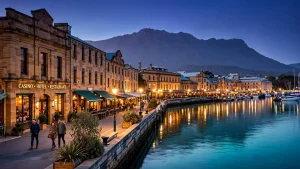 Hobart casino: what to verify before a visitSeparates poker tables, tournaments and EGMs, then outlines accommodation, parking, dining and other Hobart casino details that need confirmation.
For a Western Australia casino search, the useful first distinction is between a physical venue and real-money online casino play. The former requires current venue information; the latter is governed by the national restriction on Australian-based operators and the separate, unregulated status of offshore platforms. Neither search wording nor a website’s marketing language changes those conditions. Gambling should not be treated as a way to fund ordinary expenses, and increasing stakes to recover losses does not improve the underlying terms.
A casino hotel comparison is useful only when the room price and the conditions attached to it are read together. A headline rate on its own does not show whether the figure applies to the required dates, which room it covers, or what the final bill includes. For any Western Australian property, those details need confirmation against the hotel’s current booking terms before one offer can be compared with another.
The first distinction is between a room rate and a package. A room-only price should be assessed separately from an offer that bundles accommodation with another service or benefit. The value of a bundle depends on what is included, whether it can be used during the stay, and whether the room price changes when the extra is removed. A saving stated against a higher reference price is not the same as a lower payable total.
Room names are not enough to establish equivalence. A comparison needs the confirmed category, bed arrangement, occupancy limit, and any difference in view or layout that affects the booking. It should also show whether the quoted room is available for the dates being considered, rather than displaying a rate that applies only to another date or room type.
The booking total should be checked for taxes, service charges, deposits, and other mandatory costs. If any part is payable on arrival rather than at reservation, that affects the amount due at each stage even if it does not change the overall cost. A clear offer states the full amount, the payment schedule, and whether the displayed price is conditional on a particular booking method or length of stay.
Cancellation terms are part of the price calculation. A lower rate may come with restrictions on changing dates or receiving a refund; a more flexible rate may cost more but reduce the amount at risk if plans change. The comparison should record the cancellation deadline, any fee, and the consequences of a late cancellation or non-arrival. These terms should be checked for the specific room and dates, not inferred from a general hotel policy.
A Western Australia casino hotel deal should be assessed by its usable value, not by the label attached to it. Any included credit, meal, parking, or other benefit needs its own conditions: where it can be used, when it expires, whether it is limited to particular guests, and whether it can be exchanged for cash. An advertised extra that cannot be used during the stay does not reduce the amount paid for the room.
 Melbourne Casino Guide: Hotels, Dining and Venue DetailsCompare casino-complex rooms, linked hotels and separate stay packages, and check booking terms, venue details, dining and other common searches.
 Casino in Sydney: Hotels, Rules and ClaimsLearn how to distinguish on-site casino accommodation from nearby stays, and why hotel offers and venue details need separate confirmation.
The same care applies to eligibility. Offers can be restricted by booking channel, date, room category, or membership status. The terms should identify whether a discount is automatic or requires a code, whether it can be combined with another offer, and what happens if the reservation is changed. Without those conditions, two advertised deals may not be comparable on equal terms.
For a casino hotel in Western Australia, a practical comparison therefore needs a dated quote for the same stay, matching room categories, the full payable total, cancellation and change rules, and a clear account of each included benefit. Rates and inventory can change, so a figure should be treated as valid only for the dates and conditions shown at the time of booking. Any offer should be read through to its final terms before it is treated as a saving. A hotel room is a purchase; the headline discount is merely one line in its calculation.
A poker room and a poker-machine area are different facilities. Poker tournaments involve players competing at tables under an event’s format and entry conditions; Electronic Gaming Machines (EGMs) are gambling machines. A venue’s information about one does not establish what it offers for the other.
That distinction matters when assessing claims about a Western Australian casino poker room or tournament. A listing for a sports bar, gaming floor or casino hotel does not, by itself, confirm a dedicated poker room, scheduled tournament or public entry. Each is a separate operational detail, and event availability can depend on the venue’s current programme.
A poker room and a poker-machine area are different facilities; tournament information does not establish the availability of cash games, and vice versa.
Tournament information is useful only when its terms are clear. A complete event notice would identify the format, registration process, start time, entry cost, prize structure, eligibility conditions and any rules for late entry or re-entry. It should also indicate whether the event is open to the public or limited to members or invited participants. Without those details, a tournament name alone provides little basis for comparing events.
Poker-room conditions also need to be distinguished from tournament terms. The room’s operating schedule, games offered, table availability, minimum stakes and admission requirements are not interchangeable with an event listing. A published tournament schedule does not establish that cash games are running, while a room description does not confirm that a tournament is taking place on a particular day.
Searches for “casino rooms” can refer to hotel accommodation rather than poker facilities. A room photograph or hotel booking page therefore should not be read as evidence of a poker room. Likewise, a sports bar listing may establish a dining or viewing facility, but not poker tables or tournament access. These categories need separate confirmation from the venue’s own current information.
Poker-machine statistics from another state are not evidence about Western Australia poker facilities. Club Liverpool’s position among NSW clubs concerns operational poker machines, not poker rooms or poker tournaments in WA. NSW rules for poker machines, including the state’s pre-commitment arrangements, cannot be used to infer the format, legality or availability of a Western Australian poker event.
Online poker is a separate matter again. Under the Interactive Gambling Act 2001, online poker offered as a real-money gambling service to people in Australia is restricted for operators. That does not establish whether a land-based venue has a poker room or holds a tournament; physical facilities and online services are different questions.
For a tournament, the financial comparison is the amount paid to enter against the published prize structure and the conditions attached to participation. A prize pool is not a guaranteed return for an individual player. Rebuy or re-entry conditions, where offered, affect the total possible spend and should be treated as part of the event cost, not as a route to recover losses. Increasing stakes to recoup losses does not change the underlying uncertainty. Any session budget should be fixed in advance and remain within the available bankroll.
Identification and entry requirements should be checked against the venue’s current rules. Requirements for gambling on EGMs should not be mistaken for proof of tournament admission rules, and poker-event terms should not be assumed to apply to machine play. The useful result is a clearly identified facility and event, with current conditions attached—not a venue category or state statistic standing in for them.
Accommodation near a casino in Western Australia is a separate choice from booking a room inside the venue. The useful comparison is between independently operated hotels, motels, serviced apartments and other nearby lodging, assessed against the actual destination and the full cost of reaching it. A property described as “near” may still require a drive, while a short map distance does not establish that a route is practical on foot.
The venue’s confirmed location is the starting point. Once that is established, nearby properties can be compared by route rather than by promotional wording: walking access, public transport, taxi or rideshare options, and the time needed to travel at the relevant hour. Map listings can help identify candidates, but operating details and routes should be checked against current property and transport information. A pin on a map is not a transfer plan.
A low headline rate is not necessarily the lowest-cost stay. The final comparison should include the accommodation charge, any applicable taxes or fees, transport to and from the venue, and parking if a vehicle is involved. Parking arrangements need particular care: availability, access conditions and charges may differ between the accommodation provider and the casino destination. A room rate that excludes parking can change the total materially.
Accommodation deals should be read as contract terms, not as a discount label. The relevant details include the dates when the price applies, whether the rate is refundable, the cancellation deadline, any deposit or prepayment requirement, and charges that appear only at checkout. Restrictions can make a lower advertised price unsuitable for a stay whose dates may change. The comparison is the amount payable for the intended dates under the applicable conditions, not the largest discount displayed.
The booking record should also identify the actual property, room occupancy, included services and payment conditions. Third-party listings may describe a property differently from its own booking page, so the final confirmation is the operative document. An accommodation promotion should not be treated as a casino promotion: a lodging discount concerns the stay and does not establish any benefit at the venue.
The most suitable location depends on the purpose of the trip. A stay focused on the casino may prioritise a simple route and late transport options; a broader visit may give greater weight to other destinations, quiet surroundings or facilities at the accommodation itself. These are different trade-offs, and a single “closest” label does not resolve them.
For parking near the casino, the useful questions are practical: whether spaces can be reserved, whether access is available at the planned arrival time, and whether leaving the vehicle overnight is permitted. Those conditions should be confirmed with the relevant operator rather than inferred from a nearby property’s description. The same applies to shuttle services or transport partnerships: a mention in an old listing does not guarantee current service.
A defensible shortlist therefore links each property to a confirmed venue location, a workable route, and a complete price under the booking conditions. Without those elements, “nearby” and “deal” remain marketing descriptions, not comparable measures.
A Western Australian casino contact number, email address or physical address should not be treated as current unless it appears on the venue’s own, recently maintained information channel. Third-party directories can retain details after they have changed. A listing is useful for locating a source, not for confirming that a number still reaches the venue or that a department handles the enquiry.
Attention: Third-party directories may contain outdated contact details, opening hours, or dress requirements; always verify information via the venue's official channels.
The same check applies to practical details. Opening hours, dress requirements, event schedules, parking arrangements and maps can change, and an old listing may describe a past arrangement. Before making plans, compare the relevant information with the venue’s current website or contact channel. For time-sensitive matters, direct confirmation is more useful than a copied directory entry. A map should also be checked against the venue’s own directions, particularly where an entrance, access route or parking location matters.
A request about a bar, car park or concert is a venue-information question; the wording alone does not establish that a particular facility or event is available. The relevant details are the specific location, date and conditions applying at that time. An event listing, for instance, needs to identify the event and its schedule, while parking information needs to clarify where access is provided. Without confirmation from the venue, those details should not be treated as established.
Game searches require a separate distinction between physical-venue information and online access. Baccarat or craps in a query does not confirm that a Western Australian venue offers either game, nor does it establish current table availability or session arrangements. Those points need confirmation directly from the venue. They should not be inferred from a general casino description or from information about another property.
Online casino games are a different matter. Under the Interactive Gambling Act, operators based in Australia are restricted from offering online casino games such as pokies, blackjack and roulette to people in Australia. That rule is context for online-game searches, not a recommendation to use an offshore platform and not evidence about the games or services offered at a land-based venue.
A careful information check keeps each question in its proper category: contact details and directions from a current venue source; hours, dress expectations and event schedules confirmed for the relevant visit; and game availability verified rather than assumed. Search results can point towards information, but they do not make outdated details current.
Breakfast and buffet searches concern a specific venue’s current service, not a standard feature that can be assumed from the word “resort”. Before treating breakfast as part of a casino visit, the relevant details are whether it is served on the requested date, whether it is included with a room or sold separately, and what conditions apply to access. The same checks matter for a buffet: availability, service times, menu and price can change, so an old listing or a general description of a Western Australian casino resort is not a reliable basis for a booking decision.
The word “rewards” also needs a clear referent. A venue loyalty programme and an online gambling bonus are different products, with different eligibility rules and ways of calculating value. No particular Western Australian venue’s rewards terms can be inferred from a general search for casino rewards. For a venue programme, the useful comparison is the benefit actually offered against its qualifying conditions, expiry rules and any exclusions—not the headline label.
Online bonuses require a separate calculation. A free-spin award does not necessarily become withdrawable cash at its displayed value. A report on psu.com describes free-spin winnings as subject to wagering requirements ranging from 20x to 50x; that is a reported range, not a fixed market rule or a term for a named Western Australian casino. A specialist review gives a separate example in which free-spin winnings must be wagered 30 times before withdrawal. These figures should not be combined into a supposed standard offer: the applicable condition is the one in the specific bonus terms.
Legal Risk
Real-money online casino games are prohibited for Australian-based operators under the Interactive Gambling Act 2001, and offshore platforms are not regulated under Australian law.
The multiplier determines how much qualifying wagering is required against the defined bonus winnings. The definition matters: terms may specify which games count, whether contribution differs by game, and whether a maximum cashout applies. They may also include clauses that void winnings if conditions are breached. A headline bonus therefore cannot establish the amount ultimately payable; the complete terms and the calculation basis are decisive.
That distinction is particularly important in Australia. Real-money online casino games are prohibited for operators providing them to people in Australia under the Interactive Gambling Act 2001. Offshore platforms are not regulated under Australian law, and their bonus terms are not evidence of an offer from a local land-based venue. Offshore operators may also provide limited dispute-resolution options, and winnings may be at risk if an operator becomes insolvent. A bonus with a large stated value can have little practical value if its conditions make withdrawal difficult or unavailable.
Employment searches are another separate matter. Casino jobs, resort roles and hospitality vacancies require confirmation through the relevant employer’s current careers information; breakfast or rewards details say nothing about available positions, duties or employment terms. No venue-specific vacancy should be assumed from a general search phrase.
For any breakfast, buffet, loyalty benefit or job enquiry, the decision-grade information is the current property or employer’s own confirmation. For online bonuses, it is the complete written condition set and the resulting withdrawal rules—not the promotional headline.
Opening hours, reopening announcements and event schedules are separate questions from whether an online game can be accessed. A Western Australian venue’s hours or entertainment calendar can change; development or employment news does not establish that a venue is open, hosting an event or accepting bookings. Those details need to come from a current announcement by the venue or another responsible source. An old event listing is not evidence of a current programme.
The same distinction applies to menus. A menu listing may relate to a particular outlet or event rather than the venue as a whole, and it does not confirm opening times. A review can describe an earlier visit, but it cannot settle whether hours, entertainment or facilities remain the same. Without current venue information, no opening time, reopening date or event should be treated as confirmed.
Online game access follows a different mechanism. Region blocking uses the player’s IP address to estimate geographic location. When a game is excluded for an Australian location, it may not appear in the lobby when accessed from an Australian IP address. A specialist review has also described games failing to load because of a regional restriction; a loading failure alone does not establish the precise cause or show that the game is temporarily unavailable everywhere.
This can make an online lobby look different from a list of games described elsewhere. Game availability can depend on the player’s apparent location and the restrictions applied by the operator or provider. A missing title is therefore not evidence that a Western Australian venue has closed, reopened or changed its entertainment programme. Venue announcements and online access information answer different questions.
Verifying Game Access
Check the Lobby
Observe if the game appears in the online lobby when accessing from an Australian IP address.
Identify Restrictions
Determine if a missing title is due to region blocking by the operator or provider.
Review Terms
Consult the site's terms of service regarding regional access and the use of VPNs.
A VPN can make an internet connection appear to come from another location. Using one to bypass a site’s regional restrictions violates the site’s terms and may lead to account suspension. It is not a reliable way to establish whether a game is available, and a changed IP address does not change the terms governing access.
For a practical review of a venue, the useful evidence is dated and specific: an official notice confirming opening status, a current event listing, or a direct update from the venue. Employment or development announcements may indicate a change is planned, but do not by themselves confirm that doors have opened or an event is taking place. For game access, the lobby and the applicable site terms are the relevant indicators; venue schedules cannot confirm them. These checks should remain separate rather than being combined into a single claim about whether a casino is open.
Restaurant information attached to a casino search needs to be treated as a separate decision from the venue’s gaming facilities. A property may have dining options on site, nearby restaurants may appear in the same results, and listings can combine the two without making the distinction clear. The location and operator should therefore be confirmed before relying on any restaurant description.
A useful comparison starts with the practical details that affect the meal and its final cost: cuisine, menu, service style, dietary options, booking arrangements and the full price of what is ordered. A menu image or summary may not show current dishes, surcharges or whether a listed option is available at the intended service. The relevant measure is the amount payable for the planned meal, not a headline price detached from its conditions.
The difference between on-site dining and nearby dining also matters. A restaurant described as being “at” a casino should be confirmed as part of the property rather than merely close to it. For a restaurant outside the venue, the route, transport and time required become part of the practical comparison. A map label alone does not establish that the restaurant is operated by the casino or that access is direct.
Before making a booking or travelling, the venue’s current restaurant information should be checked for the specific date and service. Menus, reservation requirements, seating arrangements and availability can change. Where dietary needs matter, a general menu description is not enough: the relevant dish and any accommodation should be confirmed with the restaurant. A booking confirmation should also identify the restaurant and any conditions attached to the reservation.
Cost comparisons should use the same basis. Check whether the quoted amount covers the intended dishes and service, and whether drinks or other items are separate. If a set menu or special offer is listed, its eligibility, included items and booking conditions determine its actual value. Without those terms, an advertised price cannot be compared reliably with another meal.
Searches for casino restaurants in Western Australia can also bring up broad regional listings rather than information for one identifiable property. Restaurant names, menus, prices and opening times should not be treated as current merely because they appear beside a casino listing. Confirmation from the venue or restaurant is the useful final check; an unconfirmed listing is not a dining plan.
Restaurants operated by the casino property, requiring confirmation of direct access and official affiliation.
External restaurants that may appear in search results, requiring a separate assessment of route and transport.
Specifics including current menus, dietary options, and final payable amounts for the planned meal.
An address is the first detail to establish before treating a venue listing as a practical destination. A reliable listing should identify the casino by its current official name and give a street address that matches the venue’s own site or another authoritative venue source. A map pin, directory entry or old travel page may point to a precinct rather than a particular entrance. That distinction matters when planning arrival, arranging transport or checking whether a listing refers to the casino itself.
Bars, a day spa and other facilities are separate claims, not automatic features of a casino. A venue page should identify each facility clearly and show that the information applies to the location in question. A photograph or general description of a hotel or entertainment precinct does not establish that a particular bar or spa is on site, currently operating or open to the public. Names, access arrangements and service details should therefore be taken from current venue information rather than inferred from nearby businesses.
Dress requirements also need a venue-specific source. A general statement about casino attire cannot establish the rules for every area or event; requirements may differ between gaming spaces, bars and special occasions. Where the venue publishes a dress policy, its wording is more useful than an undated directory summary. If no current policy is provided, a precise dress-code claim should not be treated as confirmed.
Careers information belongs to another category again. Job advertisements should be checked on the operator’s official recruitment page, where the employer, role and application process can be identified. A search result or third-party vacancy listing may be outdated, and a venue name alone does not establish who employs staff in a particular facility.
Casino game information should likewise be tied to the specific venue and its current official material. The presence of bars or a spa says nothing about which games are available. Nor does a property listing establish online access: under the Interactive Gambling Act 2001, operators based in Australia cannot provide real-money online casino games such as pokies, blackjack or roulette to people in Australia.
For a Western Australian casino, address, bars, spa services, dress rules and vacancies each require their own current confirmation. Treating them as one bundled set of assumed amenities turns a location label into claims the label cannot support.
Food-court facilities, general food service and a swimming pool are separate features, not automatic parts of a casino visit. A Western Australian venue should not be assumed to have any of them without confirmation from its current official information.
For food, the useful details are practical: whether service is available on site, what type of food is offered, where it is served and when that service operates. A food court suggests multiple choices in a shared area; it does not establish which outlets are present, whether they are open, or whether service is available to all visitors. General references to food are less specific still. They do not confirm a café, takeaway counter or other particular format.
Pool access also needs its own confirmation. A pool may be part of a hotel or leisure facility rather than a casino’s public amenities, and its availability may depend on access conditions. A general venue description cannot establish whether a pool exists, where it is located, or who may use it.
These distinctions matter when comparing facilities. An advertised food service does not prove that a food court is available, and neither establishes pool access. Current venue information is the appropriate basis for confirming the facility, its location, operating arrangements and any access conditions. If those particulars are not stated, they should remain unassumed rather than treated as part of the property offer.
Yes. The Interactive Gambling Act prohibits Australian-based operators from offering online casino games such as pokies, blackjack and roulette to people in Australia. Offshore platforms are not regulated under Australian law.
Pokies region blocking prevents games from being accessed in selected locations. Casinos or software providers can use a player’s IP address to identify their location and block games for excluded countries.
A casino or software provider checks a player’s IP address to estimate their location and can block access from excluded countries. Blocked games may not appear in the lobby or may fail to load.