See how browser access differs from a native app, what free play can establish, and which payment, bonus and connection details affect mobile play.
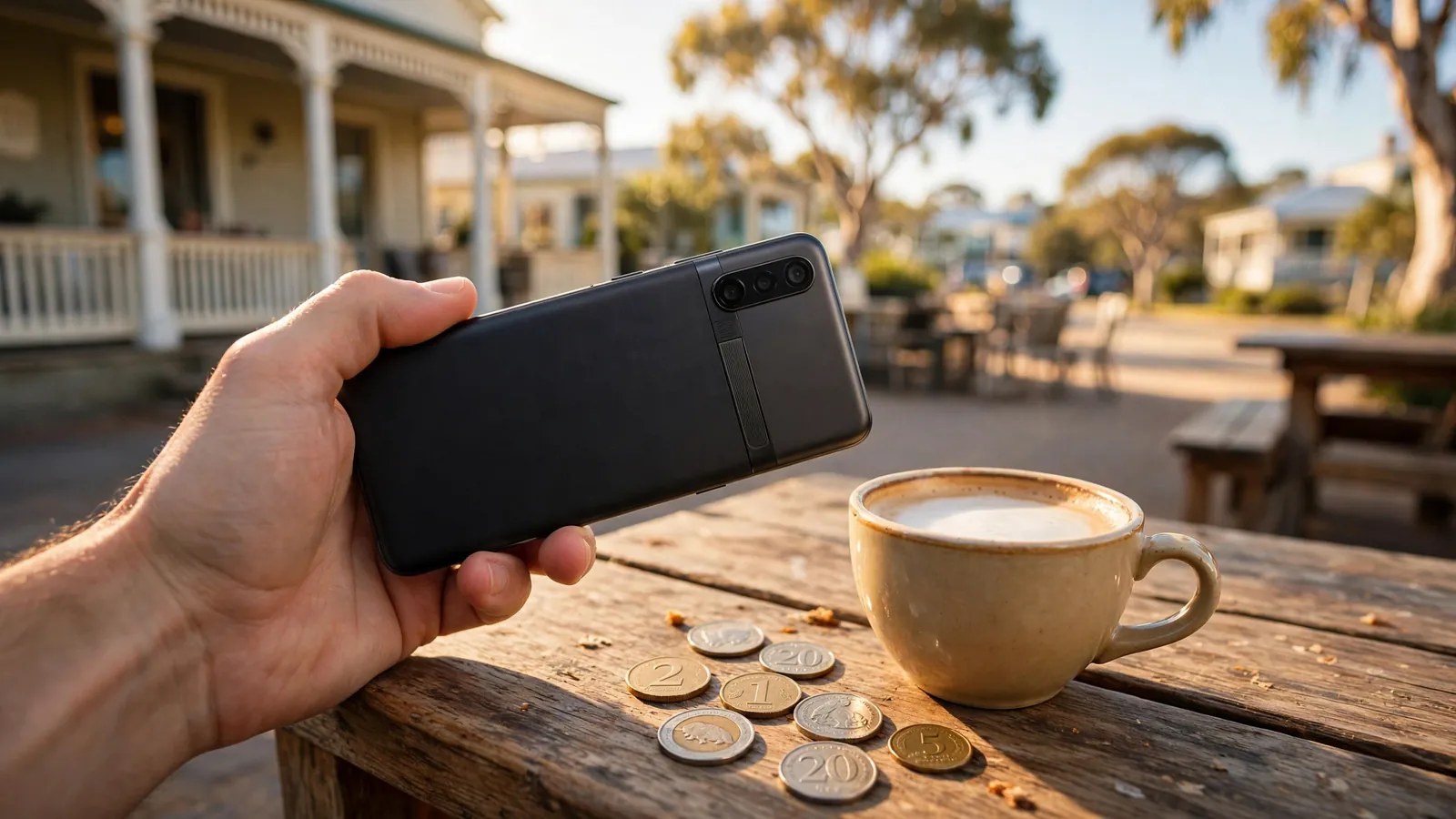
An Android phone can reach a casino website without having a casino app installed. For services that accept people in Australia, browser access is the usual format: the site opens in a mobile browser, and the account is the same one used on desktop. The screen may be arranged for a smaller display, but the underlying access is still through the website.
That distinction matters when a search is for a real-money pokies app for Android. A page that works on a phone is not necessarily a native app. If it opens in Chrome or another browser, the browser is loading the casino website; it is not launching software installed from Google Play. Casino apps are rarely listed in Google Play or Apple’s App Store in Australia, which helps explain why browser play is the default rather than an exception.
A native app is installed as a separate program on the device. A browser session does not require that installation: the punter visits the site and signs in there. The practical difference is where the software comes from and how it is accessed, not simply whether the display looks app-like. A website can be designed to resemble an app while remaining a website.
Choosing real-money pokies for Android in Australia calls for attention to practical details as well as licensing. Use these short operator notes to see which listed facts may help you decide what to check before playing.
7Bit Casino
7Bit Casino is listed as licensed in Curacao and operated by Dama N.V. These details identify its stated licensing and operator.
Wild Tokyo
Wild Tokyo lists a A$10 minimum deposit and Curacao licensing. Its stated payout times are 30–60 minutes for crypto and 1–5 days for fiat.
SkyCrown
SkyCrown is licensed by the Tobique Gaming Commission and lists a A$30 minimum deposit. Its stated payout times are around 10–15 minutes for crypto and 1–5 days for fiat.
Neospin
Neospin lists a Curacao Gaming Control Board OGL/2023/176/0095 license held by Hollycorn N.V. This gives readers a specific licensing detail to consider.
Uptown Pokies
Uptown Pokies has operated since 2017, according to the supplied details, and lists a A$20 minimum deposit. It is licensed in Curacao.
WinSpirit Casino
WinSpirit Casino lists a A$30 minimum deposit and a Curacao eGaming OGL/2024/923/0383 license held by Antillephone N.V.
DragonSlots Casino
DragonSlots Casino is listed under a Curacao Gaming Authority license, with Jumpman Gaming Ltd as the named operator.
Thor Casino
Thor Casino lists a €20 minimum deposit. Its stated license is Curacao – Antillephone N.V., with Versus Odds B.V. named alongside it.
Vegaz Casino
Vegaz Casino lists a Curacao OGL/2024/1335/0780 license and a €20 minimum deposit. Those are the available details for assessing it from this listing.
LuckyVibe
LuckyVibe lists a Curacao Gaming Control Board OGL/2023/176/0095 license held by Hollycorn N.V. This provides a specific licensing detail, with no other operator attributes supplied.
Some operators also offer a Progressive Web App, or PWA. It is a website shortcut that can behave more like a native app on a mobile device. That can make the site easier to reopen, but it does not turn the service into an app distributed through an official app store. The installation prompt appears on the casino website. The mechanics of adding a PWA are separate from the broader question of whether the service is lawful or appropriate to use in Australia.
A third route is sideloading: installing an app file obtained outside an official app store. That is not the same as downloading a store-listed app, and it introduces a security risk. The file’s safety depends on the operator supplying it and on the integrity of the download. A familiar logo or a page calling a file an Android casino app does not establish that the software is safe. An app can request access to device functions or handle account information, so its origin matters more than the label attached to it.
Sideloading also changes who stands between the user and the software. An official store provides a distribution channel; a direct download relies on the operator’s own process. Neither an app icon nor an installation screen confirms that the operator is trustworthy. If an offshore crypto-friendly casino provides a downloadable app, the app remains offshore software, and its safety depends on that operator. This is a description of the format, not a recommendation to install or use one.
The same distinction applies to searches for an Aristocrat pokies app on Android or a particular pokies network’s app. A search phrase cannot establish that a specific title or catalogue is available in a native app, nor that a file offered on a website is genuine. The reliable technical question is narrower: does the service open in a browser, offer a PWA shortcut, or ask for a separate app download? Those are different delivery methods, and none by itself verifies a game or the operator.
Australian law sets an important boundary around this access. The Interactive Gambling Act 2001 prohibits operators from providing real-money online casino-style games to people in Australia. ACMA blocks access to illegal gambling sites. Offshore casinos may still be encountered online, but their presence is not evidence that they are locally authorised. A punter must confirm that a site accepts their location before depositing; using a VPN to reach a blocked casino may void winnings and lead to account closure. If an offshore casino refuses a payout, there is no Australian government body to handle the complaint.
The practical summary is plain: an Android browser is commonly the access point, a PWA is a website shortcut, and a sideloaded app is a separate download with operator-dependent security. None of these formats changes the service’s legal position, proves that a particular pokies title is available, or provides protection if an offshore operator disputes an account or payment.
Legal Risk
Using a VPN to access blocked casinos may void your winnings and lead to account closure. There is no Australian government body to handle complaints if an offshore operator refuses a payout.
Free-play casino apps occupy a different category from real-money casino access. They use virtual credits rather than a cash balance, and social and free-play apps of this kind are available through the Google Play Store and Apple App Store. In Australia, using these apps is legal. Their presence in an official app store does not, by itself, say anything about real-money services.
The distinction is in what the balance represents. Virtual credits are part of the app’s play format; they are not a deposit balance simply because they appear beside a game or are counted in a wallet-style display. A free-play session can reproduce the visual structure of casino-style play without establishing that funds can be deposited or winnings withdrawn. The screen may look familiar, but the accounting is different.
That difference matters when an Android app is described as “free”. The word can refer to access to the app or to play with virtual credits; it should not be read as a statement about every feature, purchase option or condition within an individual product. Store availability establishes that the app can be obtained through that store. It does not establish that every mode is free, that credits have a cash value, or that a real-money account is available.
A useful way to read the format is to keep three questions separate: what can be installed, what balance is used during play, and whether the app provides any real-money service. For a free-play app, the stated format is virtual-credit play. The other questions require information specific to that app and should not be answered from its icon, title or screenshots alone.
The same separation applies to searches for free pokies on Android phones. A result may lead to a social casino app, a free-play game or a page describing a casino service. Those are not interchangeable products. An app-store listing for a virtual-credit game is not evidence that a real-money casino app is available there, and a website that opens on an Android device is not automatically an app-store download.
Official distribution is relevant, but it has a limited meaning. Google Play and Apple’s App Store provide routes for obtaining social and free-play casino apps. The listing does not certify that an app’s play is equivalent to cash gambling, nor does it convert virtual credits into withdrawable winnings. Availability and financial function are separate facts; combining them produces a misleading description.
The label “free” also does not settle the app’s full commercial terms. It identifies neither how credits are supplied nor whether the app offers optional purchases. Those details can differ between products and are not established by the general category. A careful description should therefore avoid treating all free Android casino apps as having identical credit rules. The point that can be relied on at category level is narrower: social and free-play apps use virtual credits and can be found in the official stores.
For a punter comparing formats, the practical boundary is straightforward. Virtual-credit play is entertainment within an app’s own credit system; it is not a cash account merely because the interface resembles one. If the distinction is unclear in a listing or in the app itself, the wording around the balance and its use matters more than the game imagery. A familiar table, reel or coin graphic is interface design, not evidence of a monetary feature.
This is also why a free Android download should not be treated as a shortcut to real-money play. The download establishes access to that app, not access to a separate casino service. The app’s stated credit format is the relevant starting point, and claims about cash deposits, cashouts or real-money play need to be assessed independently rather than inferred from the presence of casino-style games.
Free-play apps have a defined use: virtual-credit play through products distributed in official app stores. That makes them distinct from real-money access without making them a substitute for it. The distinction is simple in accounting terms: a virtual balance belongs to the app’s play format; a cash balance would be a different service altogether.
The legal position separates the operator’s conduct from an individual punter’s. Under the Interactive Gambling Act 2001, an operator must not provide online casino-style games to people located in Australia. That prohibition covers real-money pokies and other casino games, whether access is attempted on an Android phone or another device.
The Act does not make an Australian individual’s act of playing at an offshore mobile casino illegal. That distinction is narrow: it does not turn the operator’s service into a lawful Australian casino, or provide the protections associated with a local regulated market. A site being reachable on a phone is a technical fact, not evidence that it is authorised to provide casino games in Australia.
The Australian Communications and Media Authority (ACMA) works to restrict access by blocking illegal gambling websites. A blocked page may therefore reflect enforcement rather than a device fault. Trying to get around a block with a VPN adds a separate account risk: an offshore operator may treat VPN use as a breach of its terms, void winnings or close the account. A changed location signal does not change the underlying Australian rules.
Offshore operators may refer to licensing arrangements associated with Curaçao, the Malta Gaming Authority (MGA) or Gibraltar. Those names describe licensing jurisdictions commonly linked with operators that accept Australian customers; they are not Australian approvals. A foreign licence does not override the Interactive Gambling Act or ensure that an Australian government agency can resolve a dispute with the operator.
Before any deposit, the site’s terms must be checked to establish whether it accepts customers located in Australia. That check should include the account rules on location, verification and access restrictions, not just a registration page that loads on Android. If the operator does not accept the punter’s location, proceeding can create a dispute about eligibility and any later withdrawal.
There is also a practical limit to recourse. If an offshore casino refuses to pay winnings, no Australian government body can take up the complaint as a local casino dispute. The operator’s own complaints process may be the only route offered, and a foreign licensing body is not an Australian consumer authority. That leaves the punter dealing with the operator’s stated rules and the remedies available under its offshore arrangement.
Registration and gambling are restricted to adults: a person must be at least 18. Meeting that age requirement does not make the operator’s service lawful in Australia, nor does it guarantee acceptance by a particular offshore site. Age, location and the operator’s terms are separate checks; satisfying one does not settle the others.
The practical calculation is therefore not simply whether real-money pokies open on an Android screen. The operator is prohibited from offering the service to people in Australia, while individual play at an offshore casino is not itself prohibited by the Act. Access may also be blocked, a VPN can trigger account consequences, and a refused payment may have no Australian government complaint channel. These are material conditions of offshore access, not minor app settings.
An Android search for Aristocrat pokies can lead to two different formats: free-play apps that use virtual credits, and real-money casino access. The distinction matters more than the game artwork or name shown on a screen. A familiar theme does not establish that an app is an official Aristocrat product, that a particular title is included, or that play involves cash.
Free-play casino apps using virtual credits are available through the Google Play Store and Apple App Store, and they are legal to use in Australia. That establishes the format and distribution route, not the contents of a specific app. An app-store listing should therefore be read for what it actually says: whether credits are virtual, whether purchases are offered, and who publishes the app. Those details do not turn virtual credits into withdrawable winnings.
A request for Aristocrat pokies on Android may refer to a particular title, but the title alone is not enough to establish Android compatibility or availability. Nor does a download page become reliable because it uses a recognisable game name or images. Without a clear publisher and description of the app’s format, the label is not evidence of a verified catalogue.
The same caution applies to searches for a free Android version of a named Aristocrat game. A free-play app can provide entertainment using virtual credits, but it should not be treated as a route to cash prizes or as proof that the same game is offered for real money. The credits have no cash value unless the app’s terms explicitly establish otherwise; a claim of cash value should not be inferred from the word “pokies”.
Real-money access is a separate matter from an app-store download. Online casino-style games cannot lawfully be offered to people in Australia under the Interactive Gambling Act 2001, even where an offshore operator accepts Australian punters. Any casino considered for real-money use is offshore and crypto-friendly; that description is not an endorsement. The operator must confirm that it accepts the punter’s location before any deposit. A VPN used to reach a blocked casino may void winnings and result in account closure, and no Australian government body can resolve a complaint if an offshore casino refuses payment.
Sideloading an Android package adds another issue. An app installed from outside the official store bypasses that store’s distribution channel, so its safety depends on the operator and carries security risks. A download presented as an Aristocrat title should not be assumed safe or authentic merely because the branding looks familiar. The same applies to files shared through third-party pages or links: a game name does not verify the file’s origin.
For an app-store listing, the useful checks are the publisher, the stated credit format and the app’s own terms. For an offshore casino, the relevant questions are different: whether the site accepts Australian residents, what the service permits, and what happens to deposits and withdrawals under its rules. Registration and gambling are restricted to adults aged 18 or over. These are separate checks, not different labels for the same product.
Sideloading Risks
Installing an app from outside official stores bypasses standard distribution channels, meaning the software's safety depends entirely on the operator and carries security risks.
The practical distinction is narrow but decisive: official-store free play uses virtual credits; a search result or download label cannot verify a real-money Aristocrat catalogue for Android.
A free pokies app on Android establishes a limited fact: the app offers play without real-money stakes, using virtual credits. Social and free-play casino apps of this kind are legal to use in Australia and can be downloaded directly from the Google Play Store or Apple App Store. Their presence in an official store is relevant to that format; it is not evidence that a cash gambling service is available through the same app.
That distinction matters when assessing claims about the best free pokies app for Android. “Best” has no useful financial meaning unless the comparison identifies what is being measured. A free app can be considered in terms of its virtual-credit format, but a store listing alone does not establish that its credits have cash value, can be withdrawn, or can be transferred to another service. Virtual balances belong to the free-play experience. They should not be treated as deposits or winnings.
An official-store download identifies an app as available through that store at the time it is viewed. It also lets a user assess the app’s stated format and description before installing it. If the app presents itself as free play with virtual credits, the practical interpretation is straightforward: play occurs within that credit system, not as a real-money account.
The download does not, by itself, verify every claim made in an app description or establish how the app will operate over time. Nor does it show that a similarly named service elsewhere has the same format. Names and graphics can suggest a connection that the listing does not prove. The relevant evidence is the app’s own description of play and credits, not an assumption based on branding.
A free pokies application can therefore be suitable for trying a virtual-credit format, but its store availability should not be stretched into a broader endorsement. It says where the app can be obtained; it does not certify the quality of every feature or make a promise about future access.
A free-play app does not establish that a real-money version exists for Android, that it is available in Australia, or that an app using related branding is the same product. The app-store status of free social play and the availability of cash gambling are separate questions. Treating them as one creates a category error: virtual credits are not a route to a cash balance.
The same limit applies to recommendations for the best free pokies download for Android. A ranking would need a stated basis, such as a specific feature being compared. Without that, “best” is a label, not a measurable result. A single app’s presence in a store cannot establish that it outranks other free-play apps, and store availability alone does not support a claim about game selection or compatibility across devices.
For an Android user, the useful check is narrower. Confirm that the app is described as free play and that its credits are virtual. Read the store listing in that light, rather than interpreting free access as a sign that deposits or withdrawals are part of the app. This keeps the value of the download in proportion: it provides access to a free-play format, not proof of a cash service.
A free app can answer one question—whether virtual-credit play is offered through an official store. It cannot answer a different question about real-money access. Those are different products and should be assessed separately.
A mobile browser and a Progressive Web App (PWA) can open the same casino website, but they present it differently. Browser play stays in the browser: the site is opened at its web address, and its pages remain part of the browser experience. A PWA is a shortcut to that website, set up to behave more like a native app on the Android device. It does not mean that a separate game package has been downloaded from an app store.
For browser access, the basic distinction is therefore between opening a site and placing a shortcut to it on the device. The PWA gives the website a more app-like entry point; it is still tied to the site. Installing that shortcut does not, by itself, establish anything about the site’s operator, the games it offers or whether an account can use a particular feature.
The installation process begins on the casino website, not in Google Play. If the site provides an install or add-to-home-screen prompt, tapping it opens the installation step; the PWA is added after the installation is confirmed. The exact prompt can depend on the site and device, so a missing prompt is not proof that the browser is broken. It may simply mean the site has not offered that option in the current visit.
After installation, the shortcut provides a direct way back to the website. It should not be confused with an independent Android application: the underlying service remains the website, and the shortcut does not turn it into a locally installed catalogue of pokies. Searching for a free Android download can therefore lead to a category error. A browser page or PWA may provide access to a site without supplying a downloadable game file; the shortcut itself does not make play free.
Nor does adding a PWA establish that a particular Aristocrat title is available or compatible. The installation method concerns how the website is opened, not which titles appear within it. For a free experience, the relevant distinction is whether the product uses virtual credits, not whether its icon sits on the home screen. A shortcut is an access format, not a statement about the game’s price or payment model.
The other material difference is what the device stores. A browser bookmark or open browser tab is a browser-based route back to the site. A PWA adds a home-screen shortcut for a more app-like launch. Neither step requires sideloading an app package. Sideloaded casino apps carry security risks, and their safety depends on the operator; an app file obtained outside an official store should not be treated as safer merely because it installs successfully.
The broader access context remains important without changing the mechanics. Offshore crypto-friendly casinos are not locally authorised Australian casino services, and ACMA blocks access to illegal gambling sites. Before depositing, a punter must confirm that the site accepts their location; using a VPN to reach a blocked casino may void winnings and lead to account closure. If an offshore casino refuses payment, there is no Australian government body to handle the complaint. These are material limits, not features a PWA can resolve.
The practical choice is narrow: browser play avoids an installation step, while a PWA adds a site shortcut that behaves more like an app. Neither format verifies an operator, guarantees access, or proves that a search for free pokies has led to a free-play product. A download prompt should be read for what it is: a shortcut installation, not a verdict on the service behind it.
A deposit method describes how funds enter an account; it does not establish how quickly winnings can leave it. For mobile pokies, the payment screen may show several options, but availability and processing depend on the operator and the selected method. A specialist casino review describes PayID deposits as near-instant and typically free; that is a reported assessment, not a permanent market-wide rate.
Specialist reviews also report PayID, BPAY, cards and cryptocurrency among mobile deposit options, with processing times that differ. These options should not be treated as interchangeable. A transfer that appears promptly in an account says nothing about withdrawal approval, identity checks or the time taken by a payment provider. Some Australian banks may block or flag gambling-related card charges, so a declined payment can reflect the bank’s controls rather than a browser fault. Credit cards should not be used for online gambling.
POLi is not a current local route: it closed its Australian operations in September 2023 and no longer processes transactions in Australia. An old payment list that still presents POLi as available is out of date.
Withdrawal terms need separate attention. E-wallets such as MiFinity, Skrill and Neteller are used for deposits and withdrawals, but the casino’s pending period comes before the provider’s processing time. Specialist casino reviews report that e-wallet withdrawals can arrive within 24 hours after that pending period; the figure is not a guarantee for every account or transaction. Bank transfers can take up to five business days, according to specialist reviews. A first withdrawal may also be held for identity checks, including proof of identity and address. Some operators require a withdrawal through the deposit method, while other methods may accept deposits only.
The usable balance is therefore not the same as immediately accessible cash. Before depositing, the payment terms should be checked for fees, withdrawal eligibility, processing stages and any limits. Offshore crypto-friendly casinos remain offshore services; a punter must confirm the site accepts their location before depositing. A VPN used to reach a blocked casino may lead to winnings being voided and the account closed. If an offshore casino refuses payment, there is no Australian government body available to handle the complaint. That exposure is part of the transaction, not a footnote to it.
A mobile casino page that freezes, reloads or fails to respond may be dealing with a device or connection problem rather than a game fault. A specialist review identifies weak internet connections, limited available memory, outdated browsers and too many background apps as common causes of mobile casino problems.
Check the connection first. If it is unstable, page elements may load slowly or stop partway through. Trying again on a steadier connection can help distinguish that from a problem with the browser or device.
Troubleshooting Access
Connection Check
Verify the internet stability to ensure page elements load correctly.
Memory Management
Close unnecessary background apps to free up device memory.
Browser Update
Ensure the browser is updated to the latest version for compatibility.
Isolated Retrial
Adjust one factor at a time and retry the page to identify the specific cause.
Available memory is another factor. When little is free, a phone may struggle to keep a browser session running, particularly while other apps remain open. Closing apps that are not needed can reduce the competing load. If the browser itself is old, updating it may address compatibility issues; an outdated browser can affect how a casino page displays or responds.
Changing several things at once makes the cause harder to identify. A more useful check is to adjust one factor, then retry the page: connection, background apps, available memory, and browser version. If the same failure persists after those checks, the problem may not be local to the device.
This troubleshooting concerns access already in progress. It does not establish that a site is safe, that a particular game is available, or that a failed session will resume without interruption. A punter should avoid repeating an action involving money until the account or transaction status is clear.
An Aristocrat name on an Android screen does not, by itself, establish that a game is available for real-money play. The first distinction is the app’s format: free-play apps use virtual credits, while real-money casino access is a separate matter. A familiar title or logo is not proof of what an app offers.
Social and free-play casino apps that use virtual credits can be downloaded from Google Play and the Apple App Store in Australia. Their presence in an official store confirms only that the app is available there; it does not establish a cash-out feature or confirm a real-money version of any particular Aristocrat game.
Casino apps are rarely listed on those stores in Australia. Browser access is therefore more common for casino services, but that does not verify a particular game catalogue or make an offshore service locally authorised. Any offshore crypto-friendly casino remains subject to access restrictions. Before depositing, a punter must confirm that the site accepts their location. Using a VPN to reach a blocked casino may void winnings and lead to account closure. If an offshore casino refuses payment, there is no Australian government body to handle the complaint.
Sideloading an app does not solve the verification problem. It also carries security risks, and safety depends on the operator. The practical check is the distinction between virtual-credit entertainment and a real-money service—not the presence of an Aristocrat label. Official-store availability and a game’s branding are not substitutes for checking the format and the operator’s terms.
An Android bonus is a set of conditions, not an addition to a balance that can be treated as cash. Before claiming, the terms need to be checked for the wagering requirement, eligible games, expiry date and any cap on cashouts. A restriction on which pokies count can make the stated bonus balance less useful than it appears.
A specialist review describes welcome-bonus wagering requirements in the 30x–50x range; it characterises requirements above 40x as steep. The calculation depends on the amount named in the terms: the bonus alone or the bonus plus a deposit. The terms also determine which wagers contribute and whether a deadline applies. A specialist review reports that some offers require wagering to be completed within 7–10 days. If that period expires first, the bonus may be lost. The final value therefore depends on the qualifying amount, eligible games, time allowed and cashout cap—not just the headline offer.
These are contractual conditions, separate from gambling controls. A specialist review describes controls that may include deposit, loss and wager limits, session time limits and self-exclusion; their availability varies by casino. They do not change the bonus calculation.
Any offshore crypto-friendly casino remains subject to Australian access restrictions. A punter must confirm the site accepts their location before depositing; using a VPN to reach a blocked casino may void winnings and lead to account closure. If an offshore casino refuses payment, there is no Australian government body to handle the complaint.
Yes. Casinos that accept Australian players commonly offer access through a mobile browser, using the same account as on desktop.
A native app is separate software installed on your phone, while a browser casino loads the casino website without requiring an app installation. A PWA is a website shortcut that can behave more like an app.
Australian law prohibits operators from offering online casino-style games to people in Australia, and ACMA blocks access to illegal gambling sites. Offshore casinos may still accept Australian players, but that does not make them locally authorised.
Yes. Mobile browser access typically uses the same account as the desktop site.
Australian players are not breaking the Interactive Gambling Act by playing at offshore mobile casinos, but operators are prohibited from offering online casino-style games to people in Australia. Offshore sites are not locally authorised just because they accept Australian players.
Yes. Social and free-play casino apps use virtual credits and are legal to use in Australia. Virtual credits are not a cash balance.
A browser site, PWA or app format does not establish that a casino is trustworthy. Sideloaded apps carry security risks, and if an offshore operator disputes an account or payment, there is no Australian government body to handle the complaint.
The Interactive Gambling Act 2001 prohibits operators from offering online casino-style games to people in Australia, but playing at an offshore mobile casino is not illegal for individual Australian players.